 EKG Tech Basics
Cheat Sheet
Safety, Compliance and Patient Care
Patient ID, consent, HIPAA, infection control, electrical safety, vital signs, recognizing and reporting emergencies, CPR and AED, safe lifting, scope and charting for EKG technicians
Practice 120 Safety, Compliance and Patient Care questions free
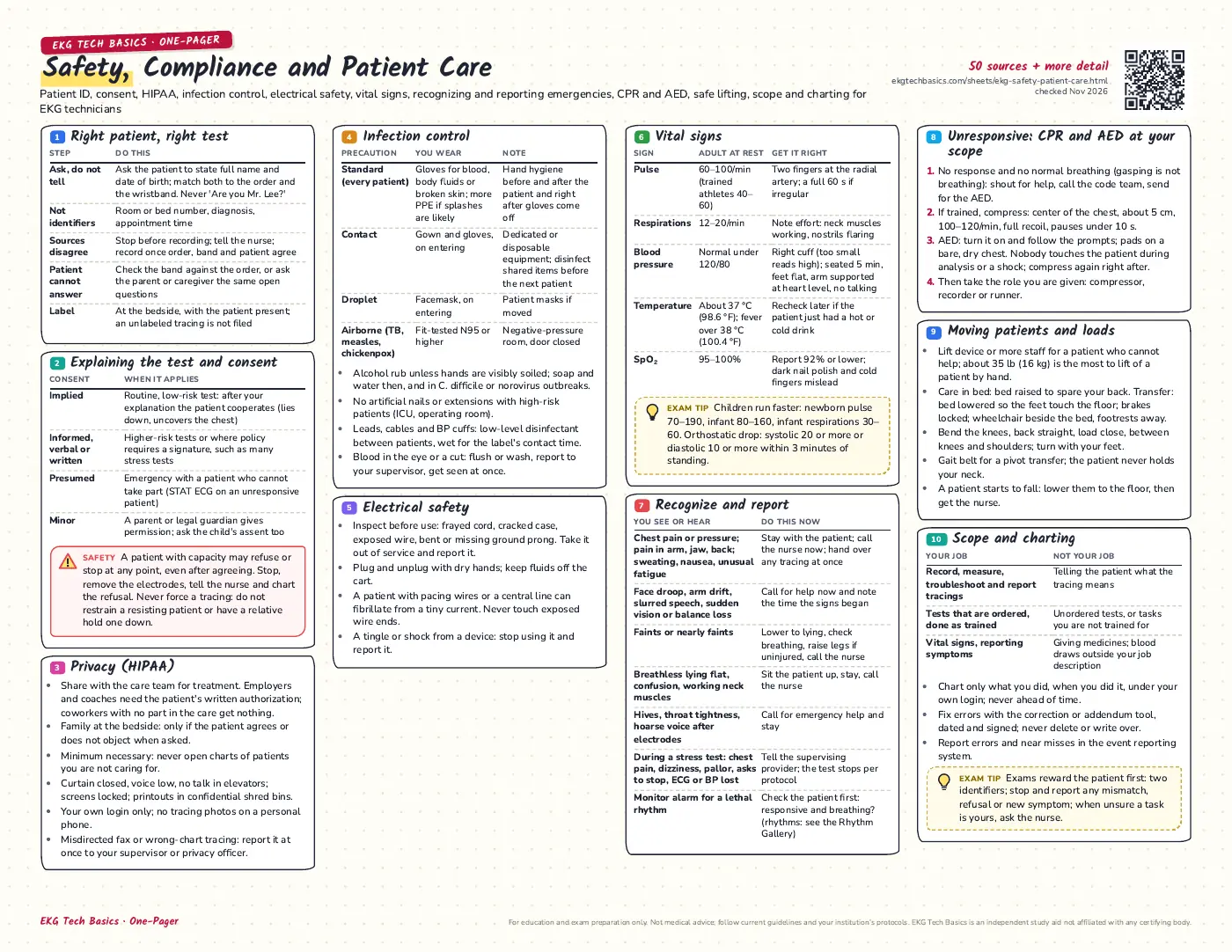
Right patient, right test
| Step | Do this |
|---|---|
| Ask, do not tell | Ask the patient to state full name and date of birth; match both to the order and the wristband. Never 'Are you Mr. Lee?' |
| Not identifiers | Room or bed number, diagnosis, appointment time |
| Sources disagree | Stop before recording; tell the nurse; record once order, band and patient agree |
| Patient cannot answer | Check the band against the order, or ask the parent or caregiver the same open questions |
| Label | At the bedside, with the patient present; an unlabeled tracing is not filed |
Explaining the test and consent
| Consent | When it applies |
|---|---|
| Implied | Routine, low-risk test: after your explanation the patient cooperates (lies down, uncovers the chest) |
| Informed, verbal or written | Higher-risk tests or where policy requires a signature, such as many stress tests |
| Presumed | Emergency with a patient who cannot take part (STAT ECG on an unresponsive patient) |
| Minor | A parent or legal guardian gives permission; ask the child's assent too |
Privacy (HIPAA)
- Share with the care team for treatment. Employers and coaches need the patient's written authorization; coworkers with no part in the care get nothing.
- Family at the bedside: only if the patient agrees or does not object when asked.
- Minimum necessary: never open charts of patients you are not caring for.
- Curtain closed, voice low, no talk in elevators; screens locked; printouts in confidential shred bins.
- Your own login only; no tracing photos on a personal phone.
- Misdirected fax or wrong-chart tracing: report it at once to your supervisor or privacy officer.
Infection control
| Precaution | You wear | Note |
|---|---|---|
| Standard (every patient) | Gloves for blood, body fluids or broken skin; more PPE if splashes are likely | Hand hygiene before and after the patient and right after gloves come off |
| Contact | Gown and gloves, on entering | Dedicated or disposable equipment; disinfect shared items before the next patient |
| Droplet | Facemask, on entering | Patient masks if moved |
| Airborne (TB, measles, chickenpox) | Fit-tested N95 or higher | Negative-pressure room, door closed |
- Alcohol rub unless hands are visibly soiled; soap and water then, and in C. difficile or norovirus outbreaks.
- No artificial nails or extensions with high-risk patients (ICU, operating room).
- Leads, cables and BP cuffs: low-level disinfectant between patients, wet for the label's contact time.
- Blood in the eye or a cut: flush or wash, report to your supervisor, get seen at once.
Electrical safety
- Inspect before use: frayed cord, cracked case, exposed wire, bent or missing ground prong. Take it out of service and report it.
- Plug and unplug with dry hands; keep fluids off the cart.
- A patient with pacing wires or a central line can fibrillate from a tiny current. Never touch exposed wire ends.
- A tingle or shock from a device: stop using it and report it.
Vital signs
| Sign | Adult at rest | Get it right |
|---|---|---|
| Pulse | 60–100/min (trained athletes 40–60) | Two fingers at the radial artery; a full 60 s if irregular |
| Respirations | 12–20/min | Note effort: neck muscles working, nostrils flaring |
| Blood pressure | Normal under 120/80 | Right cuff (too small reads high); seated 5 min, feet flat, arm supported at heart level, no talking |
| Temperature | About 37 °C (98.6 °F); fever over 38 °C (100.4 °F) | Recheck later if the patient just had a hot or cold drink |
| SpO₂ | 95–100% | Report 92% or lower; dark nail polish and cold fingers mislead |
Recognize and report
| You see or hear | Do this now |
|---|---|
| Chest pain or pressure; pain in arm, jaw, back; sweating, nausea, unusual fatigue | Stay with the patient; call the nurse now; hand over any tracing at once |
| Face droop, arm drift, slurred speech, sudden vision or balance loss | Call for help now and note the time the signs began |
| Faints or nearly faints | Lower to lying, check breathing, raise legs if uninjured, call the nurse |
| Breathless lying flat, confusion, working neck muscles | Sit the patient up, stay, call the nurse |
| Hives, throat tightness, hoarse voice after electrodes | Call for emergency help and stay |
| During a stress test: chest pain, dizziness, pallor, asks to stop, ECG or BP lost | Tell the supervising provider; the test stops per protocol |
| Monitor alarm for a lethal rhythm | Check the patient first: responsive and breathing? (rhythms: see the Rhythm Gallery) |
Unresponsive: CPR and AED at your scope
- No response and no normal breathing (gasping is not breathing): shout for help, call the code team, send for the AED.
- If trained, compress: center of the chest, about 5 cm, 100–120/min, full recoil, pauses under 10 s.
- AED: turn it on and follow the prompts; pads on a bare, dry chest. Nobody touches the patient during analysis or a shock; compress again right after.
- Then take the role you are given: compressor, recorder or runner.
Moving patients and loads
- Lift device or more staff for a patient who cannot help; about 35 lb (16 kg) is the most to lift of a patient by hand.
- Care in bed: bed raised to spare your back. Transfer: bed lowered so the feet touch the floor; brakes locked; wheelchair beside the bed, footrests away.
- Bend the knees, back straight, load close, between knees and shoulders; turn with your feet.
- Gait belt for a pivot transfer; the patient never holds your neck.
- A patient starts to fall: lower them to the floor, then get the nurse.
Scope and charting
| Your job | Not your job |
|---|---|
| Record, measure, troubleshoot and report tracings | Telling the patient what the tracing means |
| Tests that are ordered, done as trained | Unordered tests, or tasks you are not trained for |
| Vital signs, reporting symptoms | Giving medicines; blood draws outside your job description |
- Chart only what you did, when you did it, under your own login; never ahead of time.
- Fix errors with the correction or addendum tool, dated and signed; never delete or write over.
- Report errors and near misses in the event reporting system.
In depth
The one-page summary above is what the PDF prints. These sections go further.
Patient identification
A tracing filed under the wrong name harms two patients: one loses a finding and the other gains a false one. Identification is therefore done at the bedside, every time, before any electrode goes on. Ask for at least two identifiers, usually full name and date of birth, sometimes the medical record number, and ask them as open questions so the patient supplies the answer (Chang 2025). A nod to 'Maria?' proves nothing: an anxious, drowsy or hard-of-hearing patient may agree to any name. Compare the answers with the order and, for inpatients, the wristband.
- Two patients with the same or similar names on one unit, or siblings at a pediatric visit: check both identifiers on each order; a similar surname is a known trap.
- Wristband and order disagree, or the patient's answer matches only one: do not pick a source. Hold the test and tell the nurse so registration can correct the band or the order.
- Child, sedated, confused or nonverbal patient: check the band against the order, or ask the parent or caregiver the same open questions (Chang 2025). A resident with dementia and no band: the nurse verifies identity and replaces the band before you record.
- Unidentified emergency patient: use the temporary name and number registration assigns, exactly as on the band.
- Labeling: enter or confirm the identifiers on the machine with the patient present, and finish one patient before starting the next. A tracing with no name in the header is not filed under a guess; tell the nurse and repeat it.
- A wrong-chart tracing found later: report it so it is moved by the record's correction process, and file an event report.
Consent, refusal and communication
Consent rests on a patient's right to information and to choose (AMA Code 2.1.1). For routine, low-risk tests it is implied by the patient's conduct after an explanation; more invasive or risky interventions always need express informed consent, and in an emergency consent is presumed (Merck). The 2026 NHA test plan asks technicians to obtain and document implied or informed (verbal or written) consent. Which tests need a signature is set by facility policy; exercise stress testing commonly does.
- Explain before you touch: what the test is, how long it takes, what you will uncover, that it does not hurt, and what the patient must do (lie still, breathe normally, do not talk).
- Refusal is a right, not a sign of incapacity (Merck). Ask what worries the patient, answer what you can, and accept the answer. Tell the nurse so the provider learns the test was not done, and chart the refusal in the patient's words.
- Agreeing at the start does not oblige the patient to finish. If the patient says stop, stop, remove the electrodes and report.
- Patient without capacity: the surrogate (health care power of attorney or next of kin) decides whether the test is done, but the patient still takes part as far as possible. A frightened patient who resists is paused and calmed, and the nurse is told; nobody holds the patient down.
- Minors: parents or guardians give permission and the child's assent is sought, more strongly as the child matures (AMA Code 2.2.1). A grandparent or other adult saying the parents agreed by phone: hold the test and ask the nurse who may consent; state law varies.
- Witnessing a signature: you witness that this patient signed. If the patient says he does not understand or is unsure, do not witness; tell the nurse so the provider can explain again.
- Verify understanding with teach-back ('Tell me how you will press the event button'), not 'Do you understand?'.
| Barrier | What helps |
|---|---|
| Limited English | A qualified interpreter. Family, companions and children are not used, except a child or unqualified adult briefly in an emergency, or an adult the patient asks for privately with an interpreter present (45 CFR 92.201) |
| Hearing loss | Face the patient, turn off the TV, speak clearly; use written words or the patient's device |
| Aphasia or dementia | Short sentences, one step at a time, extra time to answer; explain each touch before it happens |
| Blindness | Read instructions aloud in full; ask the nurse about an accessible diary or app |
| Anxiety or anger | Calm voice, acknowledge the wait or worry, explain why each step matters; call for help if safety is at risk |
HIPAA for technicians
Protected health information (PHI) is individually identifiable health information in any form: a tracing with a name, a schedule listing patients and reasons for tests, a spoken remark about room 412 (45 CFR 160.103). Technicians are part of the covered entity's workforce, paid or not, and must be trained on its privacy policies and follow them; workforce members who do not are sanctioned (164.530(b), (e)).
| Rule | In practice |
|---|---|
| Default is no use or disclosure unless the rule allows it (164.502(a)) | Curiosity is never a reason: not a neighbor's Holter booking, not a celebrity's chart |
| Treatment, payment and operations allowed without authorization (164.506) | Sending an ECG to another provider treating the patient is allowed; verify the requester (call back a known number) |
| Minimum necessary (164.502(b)) | Ask and share only what the task needs; it does not limit disclosures to a provider for treatment |
| Authorization for other uses (164.508) | An employer, coach or personal trainer needs the patient's signed authorization; refer requests to the privacy officer |
| Family and friends (164.510(b)) | With the patient present and able: share if the patient agrees or does not object when given the chance |
| Facility directory (164.510(a)) | A caller asking for a patient by name may get the location unless the patient opted out; follow the unit's directory policy |
| Safeguards; limit incidental disclosure (164.530(c)) | Curtain and quiet voice for history questions; lock the screen; confidential shred bin; no patient lists taken home |
| Unique user ID; automatic logoff (164.312) | Log in as yourself; if another user is still logged in, log them out first |
| Mitigate harm; privacy official (164.530(a), (f)) | A fax to a wrong number or an e-mail to the wrong person is reported at once, not quietly ignored |
Images: a photo of a tracing still identifies the patient through its header, date, time and the unusual finding itself. Teaching images go through the facility's approved process, never a personal phone or a group chat. Incidental disclosure (a name overheard in a waiting room despite reasonable care) is allowed; carelessness is not. Calling a child back by first name only, rather than full name and reason for the test, is an example of reasonable care.
Infection control in detail
Standard precautions apply to every patient, whatever the diagnosis: hand hygiene, PPE chosen for the expected exposure, respiratory hygiene, careful handling of sharps, and cleaning of equipment and surfaces (CDC). Clean hands immediately before touching a patient, when moving from a soiled body site to a clean one, after touching the patient or the surroundings, after contact with blood or body fluids, and immediately after removing gloves. Gloves are not a substitute for hand hygiene. Change gloves when they are soiled or torn, between patients and before leaving the room.
- Alcohol-based rub: enough to cover all surfaces, rub until dry, about 20 seconds. Soap and water: rub vigorously for at least 15 seconds. Soap and water when hands are visibly dirty, before eating, after the restroom, and during outbreaks of C. difficile or norovirus (alcohol does not kill C. difficile spores, though CDC still prefers rub outside outbreaks).
- Nails: natural tips no longer than the fingertip; no artificial nails or extensions for direct contact with high-risk patients such as ICU and operating room patients.
- Contact precautions: gown and gloves for any contact with the patient or the room, put on as you enter and removed before you leave. Use the room's dedicated BP cuff where provided; disinfect anything shared before it touches another patient.
- Droplet precautions: facemask on entering. A coughing patient in a waiting room is given a mask and tissues and seated apart from others.
- Airborne precautions (TB, measles, chickenpox, disseminated zoster): fit-tested N95 or higher respirator, airborne infection isolation room with the door closed; staff who are not immune do not enter for measles or chickenpox if immune staff are available.
- Blood on equipment (a bleeding razor nick, a scraped knuckle on a treadmill rail): gloves, remove the visible blood, then disinfect with the facility's approved product.
| Spaulding class | Touches | Needs |
|---|---|---|
| Critical | Sterile tissue or the bloodstream | Sterilization |
| Semicritical | Mucous membranes or broken skin | High-level disinfection at least |
| Noncritical | Intact skin only: BP cuffs, and by the same definition lead wires, cables and the ECG cart | Low-level disinfection |
A disinfectant works only if the surface stays visibly wet for the contact time on its label; if it dries early, apply more (EPA). Some organisms need a specific product: on a unit with C. difficile or Candida auris, use the disinfectant infection prevention names, not the usual wipe, and follow the device maker's instructions so the leads are not damaged. Do not keep food or drink on the ECG cart. After a splash to the eyes, irrigate with clean water, saline or sterile irrigant; wash a cut or puncture with soap and water; report to your supervisor and seek medical care immediately (CDC/NIOSH).
Electrical safety in detail
Electrical injury depends on how much current flows and where it goes. Through the skin, about 1 mA tingles, 5 mA hurts, 15 mA causes sustained muscle contraction (tetany, so a person may be unable to let go), 50 mA can paralyze the breathing muscles and about 100 mA can cause ventricular fibrillation (macroshock). If the current reaches the heart directly, through temporary pacing wires, a guidewire or a fluid-filled central line, as little as 0.05–0.1 mA can cause fibrillation (microshock) (LITFL Part One). That is why patient-connected equipment is built to leak almost no current, and why grounding and inspection matter.
- Hazards OSHA names in hospitals: plugs with bent blades or a missing ground prong, cords damaged by door edges, staples or age, frayed cords or cracked housings that expose live parts, and plugging or unplugging with wet hands.
- Damaged or defective portable equipment, extension cords included, is removed from service until it has been repaired and tested (OSHA). Tag it and report it through biomedical engineering as your facility directs.
- Outlets near water must be properly grounded, and OSHA calls for ground-fault circuit interrupters (GFCIs) on standard 120-volt receptacles; do not set fluids on the ECG machine or cart.
- Use the three-prong grounded cord supplied with the machine; use only power strips and cords the facility has approved.
- Never touch the exposed ends of pacing wires, and do not let them touch metal; report an uncovered wire to the nurse.
- If a patient or staff member feels a tingle or shock from a device, stop using it, unplug it if safe, check the patient and report it.
Electrical interference on the tracing (60-cycle artifact) is a recording problem, not a shock hazard by itself; for fixes see Artifact and Lead Problems.
Vital signs in detail
| Age | Resting pulse (/min) |
|---|---|
| Newborn, 0–1 month | 70–190 |
| Infant, 1–11 months | 80–160 |
| 1–2 years | 80–130 |
| 3–4 years | 80–120 |
| 5–6 years | 75–115 |
| 7–9 years | 70–110 |
| 10 years to older adults | 60–100 (trained athletes 40–60) |
- Pulse: index and middle fingers, not the thumb; never press both sides of the neck at once. A regular pulse may be counted for 30 s and doubled; count a full 60 s when it is irregular. Let the patient rest at least 10 minutes for a true resting rate. A faint pulse that comes and goes under light pressure needs a better site or another method, not a guess.
- Respirations: one rise and fall is one breath. Note rate and effort: neck muscles working, nostrils flaring or inability to finish sentences are reported even when the rate seems normal.
- Blood pressure preparation: empty bladder; no caffeine, tobacco, food or exercise for 30 minutes; seated at least 5 minutes with back supported, legs uncrossed, feet flat; bare upper arm supported at heart level; no talking; at least two readings 1 minute apart (MedlinePlus, CDC).
- Cuff and arm errors: a regular cuff on an arm that needs a large or extra-large cuff read 4.8 and 19.5 mm Hg higher systolic; on an arm that needs a small cuff it read 3.6 lower (Cuff(SZ) trial). An arm hanging at the side read about 6.5 mm Hg higher than one supported on a desk (ARMS trial).
- Adult BP categories: normal under 120 and under 80; elevated 120–129 and under 80; stage 1 130–139 or 80–89; stage 2 140 or higher or 90 or higher.
- Orthostatic vital signs: BP and pulse after 5 minutes supine, then after 3 minutes standing. A fall of 20 mm Hg systolic or 10 diastolic within 3 minutes is orthostatic hypotension; dizziness on standing is reported and the patient sits or lies down (AAFP 2022).
- Temperature averages 37 °C (98.6 °F), with a range of about 36.1–37.2 °C (97–99 °F); over 38 °C (100.4 °F) usually means fever. After a hot or cold drink, wait and recheck an oral reading.
- SpO₂ 95–100% is normal; 92% or lower is reported, 88% or lower is urgent (MedlinePlus); some patients with COPD run lower targets set by the provider. Readings can be 2–4% off; dark nail polish, artificial nails, cold skin, poor circulation, tobacco use and darker skin pigmentation can affect accuracy.
Recognizing patient compromise
The 2026 NHA plan asks technicians to report signs needing further evaluation: cardiopulmonary compromise, altered mental status, diaphoresis, cyanosis, confusion, dyspnea and chest tightness. The technician's job is to notice, stay, call and hand over what has been recorded; diagnosis and treatment belong to the nurse and provider.
- Heart attack: chest pain, heaviness or discomfort in the center or left chest; discomfort in the arms, back, shoulders, neck, jaw or upper abdomen; shortness of breath; sweating; unusual fatigue; nausea; light-headedness; a racing or irregular heartbeat. Women more often have unusual fatigue, older adults shortness of breath, and older adults and people with diabetes may have few symptoms (NHLBI). A patient who reports a few minutes of chest tightness that has passed is still reported.
- A patient wearing an ambulatory monitor who phones with crushing chest pressure is told to call 9-1-1 and not to drive in (NHLBI: never delay calling).
- Stroke (BE FAST): balance, eyes, face droop, arm drift, speech, time. Call for help immediately and note the time the signs first appeared, because treatment depends on it (CDC).
- Fainting: a brief loss of consciousness from reduced blood flow to the brain. Lower the patient to lying, check breathing, loosen tight clothing at the neck, raise the feet if there is no injury, and call the nurse. Fainting with chest pain, a pounding or irregular heartbeat, an injury, or slow recovery needs urgent care (MedlinePlus).
- Breathing trouble: breathlessness at rest, confusion or agitation, neck and shoulder muscles working, and chest pain are red flags (Merck); Merck adds that a saturation under 90% means a serious condition, though a normal reading does not rule one out. A patient who becomes breathless when laid flat for an ECG is sat up and the nurse is told; record in a semi-upright position if the provider accepts it and chart the position.
- Allergic reaction to electrodes or tape: hives alone are reported; hives with throat tightness, a hoarse or whispered voice, swelling of the face or tongue, wheeze or dizziness can be anaphylaxis, which develops within minutes. Call for emergency help, stay, and start CPR if the patient stops breathing normally.
- Low cardiac output or poor perfusion: pallor or cyanosis, sweating, new confusion, fainting or near-fainting, or a BP that falls; report it with the vital signs and the time.
| During a stress test, tell the supervising provider at once | Why |
|---|---|
| Patient asks to stop | An absolute reason to end the test |
| Chest pain that starts or increases | Possible ischemia |
| Dizziness, unsteadiness, near-fainting; pale or blue skin | Absolute reasons: nervous-system symptoms or poor perfusion |
| ECG or BP cannot be monitored | A technical reason to stop |
| New arrhythmia, ST change, or BP that falls as the workload rises or climbs very high | The provider judges these against the lab protocol |
| Fatigue, shortness of breath, wheeze, leg cramps | Relative reasons; the provider decides |
On a telemetry station or at the bedside, a sudden chaotic tracing or flat line may be artifact or a real arrest. Go to the patient (or have the nurse go, if you monitor remotely) and check responsiveness and breathing before anything else. For what the rhythms look like, see the Rhythm Gallery; for what to say when you report, see Analyzing a Rhythm Strip Step by Step. A useful report names the patient and room, the finding and its rate, the symptoms and the time: 'Room 12, new rate of 148, racing and lightheaded for an hour; please see her now.'
CPR and the AED: the technician's part
This summary is not a course and does not replace the BLS training your employer requires; it lists what exam items test at technician level.
- Recognize arrest: unresponsive and not breathing normally. Gasping is not normal breathing, and if in doubt treat it as arrest. Take no more than 10 seconds to check (Singapore 2026).
- Get help first: shout, use the code button or number, and send someone for the AED. Do not start compressions on a patient who is breathing normally, coughing or moving.
- Compressions: heel of one hand in the center of the chest with the other on top, about 5 cm (2 in) deep, 100–120 per minute, letting the chest rise fully each time, pauses under 10 seconds (MedlinePlus). Keep the arms straight and the shoulders over the chest; a bed lowered and put in CPR mode makes that possible.
- Two or more rescuers swap compressors about every 2 minutes with as little interruption as possible (Singapore 2026).
- AED: turn it on as soon as it arrives and follow the voice prompts. Pads go on a bare, dry chest where pictured; wipe a wet chest, shave hair at the pad sites if needed, remove a medicine patch and wipe off what it leaves, and place a pad about four finger-breadths away from an implanted pacemaker or defibrillator. Everyone stands clear during analysis and the shock, then compressions restart at once; the AED reanalyzes about every 2 minutes (Singapore 2026).
- If the patient starts breathing normally or moving, stop compressions, leave the pads on, and watch breathing until the team takes over.
- Choking adult who cannot speak or cough: call for help and give the choking relief taught in your BLS course; if the patient becomes unresponsive, lower them to the floor and start CPR.
- Team role: compressor, AED operator, runner or recorder. A recorder writes every team action and its time as it happens, not only their own.
Body mechanics and safe transfers
Repeated manual patient handling causes overexertion injuries in health care workers, and OSHA's safe patient handling guidance relies on lift and transfer equipment, not technique alone. Applied to patient handling, the revised NIOSH lifting equation gives about 35 lb (16 kg) as the most a worker should lift by hand, and only for a cooperative patient unlikely to move suddenly; above that, use assistive devices (Waters 2007).
- Lifting boxes and cases: plan the route and the landing spot; get close, bend the knees, keep the spine straight, grip with both hands, tighten the abdomen, lift smoothly, keep the load close and centered, and keep the body pointed at the load. The safest zone is from mid-thigh to mid-chest; move a heavy case to a waist-high shelf rather than above the shoulders (CCOHS).
- Turning a patient for posterior leads: raise the bed to a height that spares your back, lay it flat, lower the rail on the side you turn toward, one foot ahead of the other, one hand on the shoulder and one on the hip, then rail up (MedlinePlus). A patient who cannot help needs a draw sheet and a second person.
- Patient slid down the bed: raise the bed, flatten it and use a draw sheet with help; do not drag the patient by the arms.
- Bed or table to wheelchair: only for a patient who can stand on at least one leg; otherwise use a lift. Lower the bed so the feet touch the floor, chair beside the bed, brakes on, footrests away, nonslip footwear, gait belt, pivot toward the chair, and the patient never wraps arms around your head or neck (MedlinePlus).
- After lying down, have the patient sit at the edge for a few moments in case of dizziness before standing (MedlinePlus); allow longer, and ask about dizziness, after days in bed or a pharmacologic stress test.
- A falling patient: lower them to the nearest flat surface, usually the floor, protecting the head; do not try to hold them up. Do not get them up alone; call the nurse to assess first.
- Several staff moving a heavy patient between stretcher and bed: match the surfaces' heights, lock both, use a transfer board or slide sheet, and move on one person's count.
Scope, ethics and documentation
NHA describes the CET's work as setting up and administering EKGs and stress tests, preparing patients for Holter or ambulatory monitoring, editing and delivering results to physicians for analysis, scheduling, and transcribing physicians' interpretations. Anything outside your job description and training, such as giving medicines, drawing blood where that is not part of your role, or recording special leads you have not been trained to place, is declined politely with an offer to help within your role. A patient who calls you 'the nurse' is told your role.
- The NHA Code of Ethics asks certified technicians to be honest in all professional interactions, keep learning, act in the public's best interest, and protect the dignity and privacy of every patient.
- A patient's question about the tracing ('Is my rhythm normal?') is answered honestly about your role: the provider reads it. Report anything that worried you to the nurse.
- Boundaries: no personal phone numbers or social media contact with patients, no gifts beyond what policy allows (a ring pressed on you by a confused resident goes back, and the nurse is told), and ask a colleague to take a patient you know personally.
- Do not copy yesterday's tracing as today's, change a time, or chart a test before it is done, even when asked. Each tracing is recorded fresh when ordered.
- Suspected abuse or neglect (unexplained bruises, a companion who answers every question): tell the nurse, provider or supervisor privately, before the patient leaves, and follow facility policy.
| Charting situation | Correct approach |
|---|---|
| Wrong detail in a signed electronic entry | Use the record's correction function and give the reason; the original stays visible |
| Paper log error | One line through it so it stays readable, the correction, your initials, date and time; no erasing or correction fluid |
| Charting delayed by an emergency | A late entry dated and timed when written, naming the time of the event |
| New information after charting | An addendum dated now that gives the new fact and its source |
| A coworker did the test | Chart only your own part; the coworker charts theirs |
| Patient's words matter (symptoms, refusal) | Quote them, with the time and whom you told: '1420: Patient said, "The room is spinning." Charge nurse told 1422.' |
Errors and near misses, such as a band that almost let the wrong patient be tested, are reported through the facility's event reporting system. Frontline staff who were involved usually file the first report, and these systems are generally confidential (AHRQ PSNet). Reporting a near miss is how the next one is prevented; it is not an admission of misconduct.
Related cheat sheets
- Electrode and Lead PlacementLimb and chest landmarks, counting from the angle of Louis, telemetry and Mason-Likar layouts, right-sided, posterior and 15-lead recordings, children, amputations, dextrocardia, and what to write when placement is not standard
- Artifact and Lead ProblemsTremor, 60-cycle interference, wandering baseline, loose electrodes, lead-off and cable faults, artifact that mimics VT, VF or a pause, and limb and chest lead reversals
- Paper, Settings and MeasurementThe grid, paper speed, gain and the calibration pulse, filters, heart rate methods, PR, QRS and QT in adults and children, QTc formulas and U waves
- Analyzing a Rhythm Strip Step by StepA fixed order for every strip, regularity, narrow vs wide fast rhythms, early vs escape beats, describing what you cannot name, and what to report at once
- AV Blocks, Bundle Branch Blocks and Pre-excitationCriteria tables for every degree of AV block, AV dissociation, bundle branch and fascicular blocks, and WPW, with what to measure and when to report
- Reading a 12-LeadAxis, atrial enlargement, LVH and RVH voltage, ST elevation by lead group, reciprocal change, Q waves, posterior MI, STEMI mimics, and what to report at once
Sources
- National Healthcareer Association. NHA Certified EKG Technician (CET) Test Plan, based on the 2017 job analysis. Link
- National Healthcareer Association. NHA Certified EKG Technician (CET) Detailed Test Plan, based on the 2026 job analysis. Link
- National Healthcareer Association. Certified EKG Technician (CET): what EKG technicians do and eligibility. Link
- National Healthcareer Association. NHA Code of Ethics (About NHA: boards). Link
- Chang J, Choi S, Cho H, et al. Standards and Practice Guidelines for Venous Blood Collection: Consensus Recommendations from the Korean Society for Laboratory Medicine. Ann Lab Med. 2025;45(4):343-357. doi:10.3343/alm.2025.0022 Link
- Pope TM. Informed Consent. Merck Manual Professional Edition. Reviewed August 2025. Link
- American Medical Association. Code of Medical Ethics Opinion 2.1.1: Informed Consent. Link
- American Medical Association. Code of Medical Ethics Opinion 2.2.1: Pediatric Decision Making. Link
- 45 CFR 92.201. Meaningful access for individuals with limited English proficiency. Link
- 45 CFR 160.103. Definitions (protected health information, covered entity, workforce). Link
- 45 CFR 164.502. Uses and disclosures of protected health information: general rules (minimum necessary, incidental disclosures). Link
- 45 CFR 164.506. Uses and disclosures to carry out treatment, payment, or health care operations. Link
- 45 CFR 164.508. Uses and disclosures for which an authorization is required. Link
- 45 CFR 164.510. Uses and disclosures requiring an opportunity for the individual to agree or to object. Link
- 45 CFR 164.530. Administrative requirements (privacy official, training, safeguards, sanctions, mitigation). Link
- 45 CFR 164.312. Technical safeguards (unique user identification, automatic logoff, audit controls). Link
- Centers for Disease Control and Prevention. Standard Precautions for All Patient Care. Link
- Centers for Disease Control and Prevention. Transmission-Based Precautions. Link
- Centers for Disease Control and Prevention. Clinical Safety: Hand Hygiene for Healthcare Workers. Link
- Centers for Disease Control and Prevention. Guideline for Disinfection and Sterilization in Healthcare Facilities: A Rational Approach to Disinfection and Sterilization. Link
- U.S. Environmental Protection Agency. Selected EPA-Registered Disinfectants (directions for use and contact time). Link
- National Institute for Occupational Safety and Health. Bloodborne Infectious Diseases: Risk Factors (exposure first aid). Link
- Occupational Safety and Health Administration. Hospitals eTool: Electrical Safety. Link
- Life in the Fast Lane, Part One. Electrical Safety. Updated July 2019. Link
- MedlinePlus Medical Encyclopedia. Vital signs. Reviewed 1/1/2025. Link
- MedlinePlus Medical Encyclopedia. Pulse. Reviewed 1/1/2025. Link
- MedlinePlus Medical Encyclopedia. Rapid shallow breathing. Reviewed 4/1/2025. Link
- MedlinePlus Medical Encyclopedia. Blood pressure measurement. Reviewed 7/23/2024. Link
- MedlinePlus Medical Encyclopedia. Body temperature norms. Reviewed 1/1/2025. Link
- MedlinePlus Medical Tests. Pulse Oximetry. Updated September 12, 2024. Link
- Open Resources for Nursing (Open RN). Nursing Skills, 1.3 Vital Signs (LibreTexts edition). Link
- Centers for Disease Control and Prevention. Measure Your Blood Pressure. Link
- Ishigami J, Charleston J, Miller ER, Matsushita K, Appel LJ, Brady TM. Effects of Cuff Size on the Accuracy of Blood Pressure Readings: The Cuff(SZ) Randomized Crossover Trial. JAMA Intern Med. 2023;183(10):1061-1068. doi:10.1001/jamainternmed.2023.3264 Link
- Liu H, Zhao D, Sabit A, et al. Arm Position and Blood Pressure Readings: The ARMS Crossover Randomized Clinical Trial. JAMA Intern Med. 2024;184(12):1436-1442. doi:10.1001/jamainternmed.2024.5213 Link
- Kim MJ, Farrell J. Orthostatic Hypotension: A Practical Approach. Am Fam Physician. 2022;105(1):39-49. Link
- National Heart, Lung, and Blood Institute. Heart Attack: Symptoms. Link
- Centers for Disease Control and Prevention. Signs and Symptoms of Stroke. Link
- MedlinePlus Medical Encyclopedia. Fainting. Reviewed 5/19/2025. Link
- Dezube R. Dyspnea. Merck Manual Professional Edition. Reviewed November 2025. Link
- MedlinePlus Medical Encyclopedia. Anaphylaxis. Reviewed 1/20/2026. Link
- Carluccio C, Bressan F, Pizzolato M, et al. Exercise Stress Testing in Clinical Cardiology: A Practical Guide to Performance and Interpretation. J Clin Med. 2026;15(4):1656. doi:10.3390/jcm15041656 Link
- MedlinePlus Medical Encyclopedia. CPR - adult and child after onset of puberty. Reviewed 2/10/2026. Link
- Lim SH, Leong BS, Loke JH, Ng KC. Singapore Basic Cardiac Life Support and Automated External Defibrillation Guidelines 2026. Singapore Med J. 2026;67(7):406-413. doi:10.4103/singaporemedj.smj-2026-319 Link
- Occupational Safety and Health Administration. Healthcare: Safe Patient Handling. Link
- Waters TR. When is it safe to manually lift a patient? Am J Nurs. 2007;107(8):53-58. Link
- Canadian Centre for Occupational Health and Safety. Lifting - General (OSH Answers fact sheet). Revised February 2026. Link
- MedlinePlus Medical Encyclopedia. Moving a patient from bed to a wheelchair. Reviewed 10/19/2025. Link
- MedlinePlus Medical Encyclopedia. Turning patients over in bed. Reviewed 10/19/2025. Link
- Centers for Medicare & Medicaid Services. Medicare Program Integrity Manual, Chapter 3, section 3.3.2.5: Amendments, Corrections and Delayed Entries in Medical Documentation. Link
- AHRQ Patient Safety Network. Reporting Patient Safety Events (primer). Link