 EKG Tech Basics
Cheat Sheet
Exercise and Pharmacologic Stress Testing
Contraindications, preparation and Mason-Likar placement, Bruce stages, target heart rate, METs and Borg, monitoring and recovery, when to stop, the ST response, stress drugs, and the technician's role
Practice 33 Exercise and Pharmacologic Stress Testing questions free
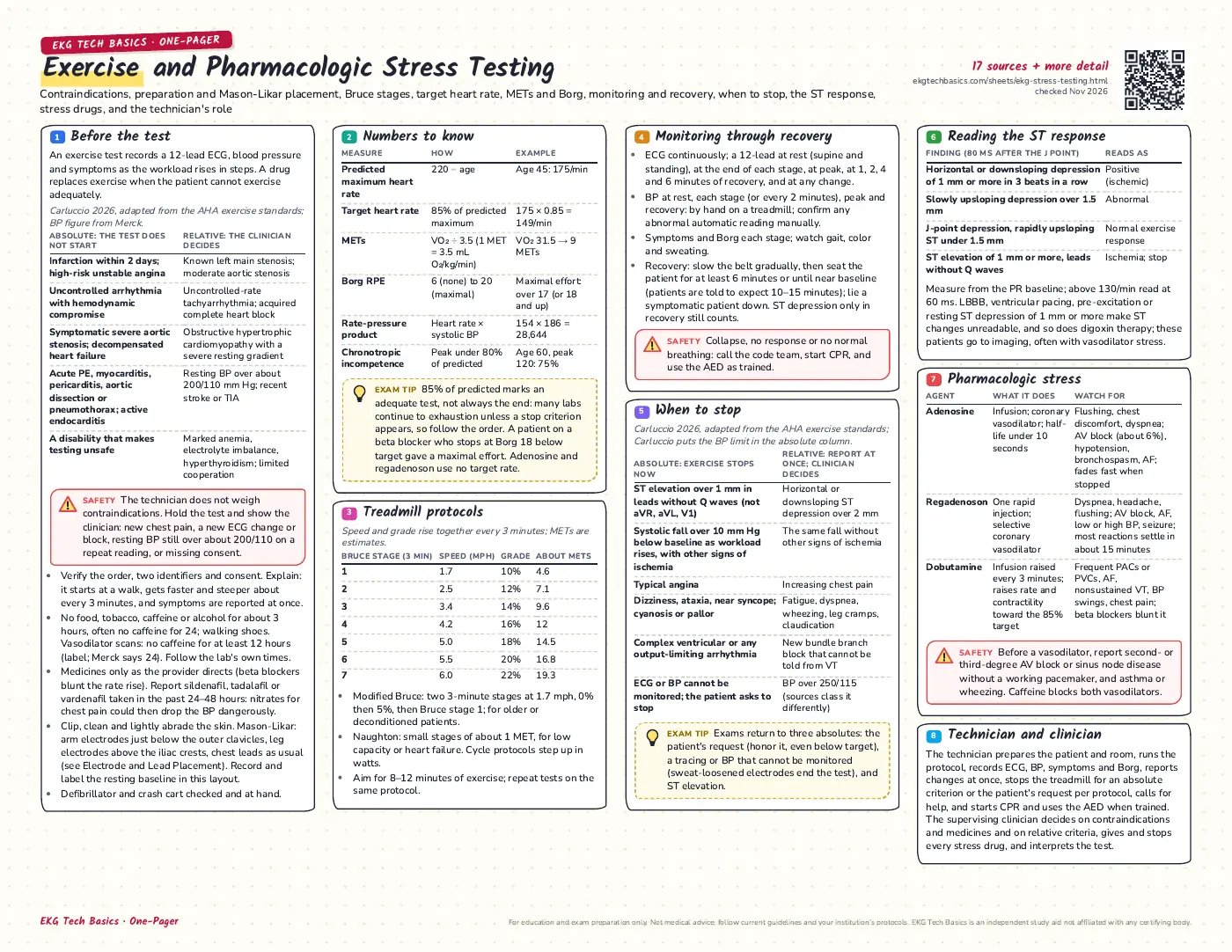
Before the test
An exercise test records a 12-lead ECG, blood pressure and symptoms as the workload rises in steps. A drug replaces exercise when the patient cannot exercise adequately.
| Absolute: the test does not start | Relative: the clinician decides |
|---|---|
| Infarction within 2 days; high-risk unstable angina | Known left main stenosis; moderate aortic stenosis |
| Uncontrolled arrhythmia with hemodynamic compromise | Uncontrolled-rate tachyarrhythmia; acquired complete heart block |
| Symptomatic severe aortic stenosis; decompensated heart failure | Obstructive hypertrophic cardiomyopathy with a severe resting gradient |
| Acute PE, myocarditis, pericarditis, aortic dissection or pneumothorax; active endocarditis | Resting BP over about 200/110 mm Hg; recent stroke or TIA |
| A disability that makes testing unsafe | Marked anemia, electrolyte imbalance, hyperthyroidism; limited cooperation |
- Verify the order, two identifiers and consent. Explain: it starts at a walk, gets faster and steeper about every 3 minutes, and symptoms are reported at once.
- No food, tobacco, caffeine or alcohol for about 3 hours, often no caffeine for 24; walking shoes. Vasodilator scans: no caffeine for at least 12 hours (label; Merck says 24). Follow the lab's own times.
- Medicines only as the provider directs (beta blockers blunt the rate rise). Report sildenafil, tadalafil or vardenafil taken in the past 24–48 hours: nitrates for chest pain could then drop the BP dangerously.
- Clip, clean and lightly abrade the skin. Mason-Likar: arm electrodes just below the outer clavicles, leg electrodes above the iliac crests, chest leads as usual (see Electrode and Lead Placement). Record and label the resting baseline in this layout.
- Defibrillator and crash cart checked and at hand.
Numbers to know
| Measure | How | Example |
|---|---|---|
| Predicted maximum heart rate | 220 − age | Age 45: 175/min |
| Target heart rate | 85% of predicted maximum | 175 × 0.85 = 149/min |
| METs | VO₂ ÷ 3.5 (1 MET = 3.5 mL O₂/kg/min) | VO₂ 31.5 → 9 METs |
| Borg RPE | 6 (none) to 20 (maximal) | Maximal effort: over 17 (or 18 and up) |
| Rate-pressure product | Heart rate × systolic BP | 154 × 186 = 28,644 |
| Chronotropic incompetence | Peak under 80% of predicted | Age 60, peak 120: 75% |
Treadmill protocols
| Bruce stage (3 min) | Speed (mph) | Grade | About METs |
|---|---|---|---|
| 1 | 1.7 | 10% | 4.6 |
| 2 | 2.5 | 12% | 7.1 |
| 3 | 3.4 | 14% | 9.6 |
| 4 | 4.2 | 16% | 12 |
| 5 | 5.0 | 18% | 14.5 |
| 6 | 5.5 | 20% | 16.8 |
| 7 | 6.0 | 22% | 19.3 |
- Modified Bruce: two 3-minute stages at 1.7 mph, 0% then 5%, then Bruce stage 1; for older or deconditioned patients.
- Naughton: small stages of about 1 MET, for low capacity or heart failure. Cycle protocols step up in watts.
- Aim for 8–12 minutes of exercise; repeat tests on the same protocol.
Monitoring through recovery
- ECG continuously; a 12-lead at rest (supine and standing), at the end of each stage, at peak, at 1, 2, 4 and 6 minutes of recovery, and at any change.
- BP at rest, each stage (or every 2 minutes), peak and recovery: by hand on a treadmill; confirm any abnormal automatic reading manually.
- Symptoms and Borg each stage; watch gait, color and sweating.
- Recovery: slow the belt gradually, then seat the patient for at least 6 minutes or until near baseline (patients are told to expect 10–15 minutes); lie a symptomatic patient down. ST depression only in recovery still counts.
When to stop
| Absolute: exercise stops now | Relative: report at once; clinician decides |
|---|---|
| ST elevation over 1 mm in leads without Q waves (not aVR, aVL, V1) | Horizontal or downsloping ST depression over 2 mm |
| Systolic fall over 10 mm Hg below baseline as workload rises, with other signs of ischemia | The same fall without other signs of ischemia |
| Typical angina | Increasing chest pain |
| Dizziness, ataxia, near syncope; cyanosis or pallor | Fatigue, dyspnea, wheezing, leg cramps, claudication |
| Complex ventricular or any output-limiting arrhythmia | New bundle branch block that cannot be told from VT |
| ECG or BP cannot be monitored; the patient asks to stop | BP over 250/115 (sources class it differently) |
Reading the ST response
| Finding (80 ms after the J point) | Reads as |
|---|---|
| Horizontal or downsloping depression of 1 mm or more in 3 beats in a row | Positive (ischemic) |
| Slowly upsloping depression over 1.5 mm | Abnormal |
| J-point depression, rapidly upsloping ST under 1.5 mm | Normal exercise response |
| ST elevation of 1 mm or more, leads without Q waves | Ischemia; stop |
Measure from the PR baseline; above 130/min read at 60 ms. LBBB, ventricular pacing, pre-excitation or resting ST depression of 1 mm or more make ST changes unreadable, and so does digoxin therapy; these patients go to imaging, often with vasodilator stress.
Pharmacologic stress
| Agent | What it does | Watch for |
|---|---|---|
| Adenosine | Infusion; coronary vasodilator; half-life under 10 seconds | Flushing, chest discomfort, dyspnea; AV block (about 6%), hypotension, bronchospasm, AF; fades fast when stopped |
| Regadenoson | One rapid injection; selective coronary vasodilator | Dyspnea, headache, flushing; AV block, AF, low or high BP, seizure; most reactions settle in about 15 minutes |
| Dobutamine | Infusion raised every 3 minutes; raises rate and contractility toward the 85% target | Frequent PACs or PVCs, AF, nonsustained VT, BP swings, chest pain; beta blockers blunt it |
Technician and clinician
The technician prepares the patient and room, runs the protocol, records ECG, BP, symptoms and Borg, reports changes at once, stops the treadmill for an absolute criterion or the patient's request per protocol, calls for help, and starts CPR and uses the AED when trained. The supervising clinician decides on contraindications and medicines and on relative criteria, gives and stops every stress drug, and interprets the test.
In depth
The one-page summary above is what the PDF prints. These sections go further.
Who does what
| Technician | Supervising clinician |
|---|---|
| Prepares the patient and room, checks the crash cart, places electrodes, records the baseline | Confirms the indication; decides on contraindications and on which medicines are taken or held |
| Runs the protocol; records ECG, BP, symptoms and Borg each stage | Interprets the ECG; decides whether to continue when a relative criterion appears |
| Stops the treadmill for an absolute criterion or the patient's request, per protocol, and tells the clinician why | Gives, adjusts and stops stress drugs, and treats complications |
| Reports new ST change, block, arrhythmia, a BP fall or symptoms at once and keeps recording | Decides whether a drug infusion stops or a protocol is extended |
| Calls for help; starts CPR and uses the AED when trained | Leads the response and writes and signs the final report |
Borg anchors used on this page: 6 is no exertion and 20 is maximal; the scale was built so that the rating times 10 roughly tracks heart rate. In a study Carluccio cites (Sirico), most healthy subjects passed 85% of predicted at a rating of only about 14, a moderate effort, which is why Carluccio treats a rating over 17 as the sign of a maximal test. The CR10 version runs from 0 to 10.
What a stress test answers
| Question | What the test looks at |
|---|---|
| Is there inducible ischemia? | ST response, angina, BP response; as a diagnostic test most useful when the likelihood of coronary disease is intermediate (Brazilian guideline); a normal result is most reassuring in lower-risk patients with a readable resting ECG (Merck) |
| How fit is the patient, and what is the prognosis? | METs reached, heart-rate and BP responses, heart-rate recovery |
| Do symptoms or arrhythmias come with exertion? | Ectopy, tachycardia, rate-related AV or bundle branch block, chronotropic incompetence |
| Specific conditions | Adrenergic arrhythmias such as CPVT, QTc in recovery for long QT, pre-excitation risk, pacemaker rate response, symptoms in aortic stenosis, mitral stenosis gradient (with echo) |
The exercise ECG alone is a modest detector of coronary disease: Carluccio puts sensitivity and specificity at 60–77%, and Merck gives 58–66% and 61–62%, lower in women. Adding echo or perfusion imaging raises accuracy. Merck puts the risk of infarction or sudden death at up to 0.06% of tests, which is why the defibrillator and trained staff are part of every setup.
Pharmacologic stress is used when the patient cannot walk long enough to reach the target, for example from deconditioning, arthritis, obesity or peripheral arterial disease (Merck). The EACVI perfusion consensus also prefers drug stress for a patient with LBBB, a patient who depends on ventricular pacing, or uncontrolled AF, because conduction disease creates image artifacts that are less evident with a vasodilator, and it allows a submaximal exercise test to be converted to a drug protocol on the spot.
Contraindications: where the lists differ
| Point | Carluccio (AHA-adapted) | Merck | Brazilian guideline 2024 |
|---|---|---|---|
| Recent infarction | Within 2 days: absolute | Within 48 hours: absolute | Under 5 days or complicated: absolute |
| Resting hypertension | Severe: relative | Over 200 systolic or 110 diastolic: relative | Persistent 180 systolic or more, or over 110 diastolic: absolute |
| AV block | Acquired complete block: relative | High-grade: relative | Mobitz II, 2:1, high-grade or complete (unless congenital): absolute |
| Absolutes not shared by the other two lists | Acute pneumothorax; active endocarditis | None | Acute febrile illness, intoxication, decompensated diabetes, recent retinal detachment, uncontrolled hyperthyroidism |
For dobutamine stress echo, the 2026 Brazilian stress echo guideline adds obstructive hypertrophic cardiomyopathy, a recent or mobile ventricular thrombus and resting BP over 200/110 mm Hg as absolute, and a thoracic or intracranial aneurysm over 40 mm as relative. Which list a lab follows is the medical director's decision; the technician's job is to notice the finding and report it before exercise or infusion begins.
Electrodes and the Mason-Likar tracing
Swinging arms and legs swamp a limb-lead ECG, so stress labs move the limb electrodes to the torso. Carluccio places the arm electrodes at the outer ends of the infraclavicular fossae and the leg electrodes on stable sites above the iliac crests; Morales-Arteaga describes the same layout as just below the clavicles and on the lower torso near the hips. The chest electrodes stay at their standard sites. Sweat is the usual reason electrodes fail mid-test, so clip hair, clean off oil and lightly abrade every site.
- The torso layout changes the tracing: the axis shifts to the right, R waves shrink in I and aVL and grow in II, III and aVF, and chest-lead R waves change too (Papouchado 1987, abstract).
- The inferior leads in this layout behave partly like anterior leads, one reason exercise ECGs miss some inferior ischemia (same abstract).
- Record the resting baseline in the same layout before exercise and keep it through the test, so changes reflect the heart rather than the electrodes (Morales-Arteaga 2026).
- Label the tracing as torso limb leads; it is not interchangeable with a standard resting 12-lead from the chart.
Protocol details
- Bruce (1973) uses 3-minute stages so the patient reaches a steady state before each increase. It reaches a higher peak heart rate and rate-pressure product than a ramp, which helps detect ischemia; its drawbacks are the large jumps between stages, which can unbalance a sedentary patient, and running in the later stages.
- Carluccio describes the modified Bruce warm-up at 2.4 km/h (about 1.5 mph); Kim 2023, Reed 2019 and the Brazilian table give 1.7 mph. Labs program their own; read the protocol on the cart.
- Under 8 minutes underestimates peak oxygen uptake; over 12 minutes, the test tends to end for leg fatigue or joint pain rather than a cardiac end point.
- The cart estimates METs from speed and grade. Holding the handrails tightly makes the estimate read high; the Brazilian guideline gives a separate correction for rail holding. Encourage a light touch for balance only, and record whether the patient held on.
- Predicted capacity for age: about 18 − 0.15 × age METs in men and 14.7 − 0.13 × age in women (Carluccio).
- Cycle ergometer: for orthopedic, vascular or neurologic limits on walking. Peak oxygen uptake is usually 5–20% lower than on a treadmill. A mechanically braked cycle needs a steady cadence; an electronically braked one holds the workload whatever the cadence. 1 W is about 6 kg·m/min.
- The belt may be slowed or briefly stopped in exceptional cases to confirm a BP or replace an electrode (Brazilian guideline); note the time on the record.
Heart rate in depth
| Item | Detail |
|---|---|
| 220 − age | Simple but variable: tends to overestimate the maximum in younger women and underestimate it in older women |
| Newer formulas | Men 208 − 0.7 × age; women 206 − 0.88 × age; 164 − 0.7 × age suggested for suspected heart disease (Carluccio). Use the one the lab sets |
| Chronotropic index | (Peak − resting) ÷ (predicted maximum − resting); under 80% is chronotropic incompetence |
| Heart-rate recovery | Abnormal at 1 minute (Brazilian guideline): a fall of 12/min or less while walking a cool-down, or 18 or less lying still; at 2 minutes seated, 21 or less. Carluccio gives the 1-minute cut-offs the other way round and under 42 at 2 minutes. Use the lab's criterion |
| Beta blockers | Blunt the rise. Carluccio holds them 24 hours only when the aim is the unmedicated response; the Brazilian exercise guideline lists 4 days (cardioselective) or 7 days before a diagnostic test, tapered; the stress echo guideline prefers 3–4 days before a dobutamine test for ischemia. Always the prescriber's call |
| Implanted devices | Know the ICD detection and therapy rates beforehand and keep the peak rate below them; the Brazilian guideline stops 10/min below the shock threshold |
Blood pressure in depth
- Measure by auscultation on a treadmill; automatic cuffs validated for exercise are acceptable, especially on a cycle, but an abnormal value is confirmed manually. The Brazilian guideline also asks for a second reading to confirm an asymptomatic drop.
- Normal: systolic rises about 5–10 mm Hg per MET, diastolic stays within about 10 mm Hg, and systolic returns to resting levels within about 6 minutes after peak.
- High at peak: limits differ. Carluccio quotes the AHA at 210 mm Hg in men and 190 in women, the ESC at 220 and 200, and the ACSM at 225 for everyone. These describe an exaggerated response, not stop criteria.
- Stop thresholds: Carluccio's table gives systolic over 250 or diastolic over 115 as absolute, with a note that athletes can exceed 250; the Brazilian guideline uses systolic over 250 or diastolic 120 or more (140 in known hypertension). Report either, after a manual check.
- Falling with exercise: a drop of 20 mm Hg or more as workload rises is pathological; with angina or ST depression, especially at a low workload, it points to severe multivessel disease. It also occurs with cardiomyopathy, outflow obstruction, high vagal tone, low volume, antihypertensives and arrhythmia.
- A low peak rate-pressure product (failure to raise either rate or pressure) signals poor cardiac reserve.
The exercise ECG beyond the ST segment
For what each rhythm looks like, see the Rhythm Gallery. This table covers what a rhythm or conduction change means when it appears with exercise.
| Finding during exercise | Usual meaning | Technician |
|---|---|---|
| PVCs at warm-up that disappear as the workload rises | Usually benign | Record and note when they faded |
| PVCs that appear or grow more complex at high workload; couplets, R-on-T | Higher risk of structural disease or electrical instability | Report promptly |
| Nonsustained or sustained VT; VF | A stop criterion; VF is an arrest | Stop, call; code team and CPR if unresponsive |
| New AF or flutter, sustained SVT | A stop criterion in the Brazilian list; a relative end point in dobutamine stress | Report at once |
| New bundle branch block at a higher rate | Rate-related block; relative stop if it cannot be told from VT | Report at once; keep recording |
| AV block that worsens with exercise | Suggests disease below the AV node (infra-Hisian) or ischemia | Report at once |
| Delta wave suddenly disappears with a normal PR as the rate rises | Accessory pathway fails at fast rates: a lower-risk sign | Record the rate at which it happened |
| Resting early repolarization fading as the rate climbs | Expected behavior | Note it |
- Isolated ST depression in the inferior leads is often a false positive from exaggerated atrial repolarization.
- Pre-excitation itself causes ST depression and T-wave inversion that can mimic ischemia.
- The PR interval normally shortens with exercise, and the QTc normally shortens; a QTc of 480 ms or more at the 4th minute of recovery suggests long QT.
Stress drugs in depth
| Agent | Labeled or guideline facts the technician uses |
|---|---|
| Adenosine | Given as a continuous peripheral infusion with the tracer injected partway through. Contraindicated in second- or third-degree AV block or sinus node disease without a functioning pacemaker, and in bronchospastic lung disease. AV block in about 6% (first-degree 3%, second-degree 3%, third-degree 0.8%). New AF typically starts 1.5–3 minutes in and usually converts on its own. Common: flushing 44%, chest discomfort 40%, dyspnea 28%, headache 18%, throat, neck or jaw discomfort 15%. Dipyridamole increases its effect |
| Regadenoson | Injected within 10 seconds into a peripheral IV of 22 gauge or larger, then a saline flush and the tracer 10–20 seconds later. Same AV block and sinus node contraindications. First-degree block in 3%; third-degree block and asystole within minutes reported after marketing. Heart rate over 100 in 22%; systolic fall over 35 mm Hg in 7%; BP can rise, especially when low-level exercise is added. Lowers the seizure threshold. Asthma and COPD are warnings, not contraindications. Dipyridamole is held at least 2 days when possible |
| Dipyridamole | Raises the body's own adenosine; reactions such as nausea, headache or bronchospasm in about 10–20%. Merck lists asthma, acute infarction, unstable angina, critical aortic stenosis and systolic BP under 90 as contraindications |
| Dobutamine | Beta-1 effect raises rate and contractility; beta-2 effect dilates peripheral vessels. Starts working in 1–2 minutes, half-life about 2 minutes, raised in 3-minute steps. Used mainly when vasodilators are contraindicated (asthma, second-degree AV block) and with echo. About half of patients report a reaction (nausea, flushing, headache, a pounding in the neck or chest, tingling, urinary urgency, dyspnea, dry mouth); serious complications under 0.1% |
Dobutamine end points in the 2026 stress echo guideline: reaching 85% of 220 − age, the end of the protocol or a limiting symptom, a new wall motion abnormality, sustained VT or complex arrhythmia, or a symptomatic fall in systolic BP (over 20 mm Hg) or in heart rate. New AF, SVT or complex ventricular ectopy and left ventricular dilatation are relative end points. When the rate will not climb, the physician may add atropine or handgrip exercise; metoprolol is kept on hand to reverse dobutamine. The technician's part is to time-stamp the dose stage, rhythm, BP and symptoms and to report a shortfall or a new rhythm.
Documenting and reporting
- Protocol, stage and time at stop, and total exercise time; the reason for stopping, in the patient's words when it is a symptom.
- Resting and peak heart rate with the percentage of predicted; resting and peak BP; rate-pressure product; METs; Borg rating at peak.
- Each ECG change with its leads, size in mm, shape (horizontal, downsloping, upsloping), the time and stage it began and when it resolved in recovery.
- Arrhythmias and conduction changes with the time and workload; recovery values at each recorded minute.
- Drug studies: the time of each injection or dose stage, reactions with their times, and what the clinician did.
- Whom you told and when: a finding reported to the clinician is documented with the time of the report.
Related cheat sheets
- Safety, Compliance and Patient CarePatient ID, consent, HIPAA, infection control, electrical safety, vital signs, recognizing and reporting emergencies, CPR and AED, safe lifting, scope and charting for EKG technicians
- Electrode and Lead PlacementLimb and chest landmarks, counting from the angle of Louis, telemetry and Mason-Likar layouts, right-sided, posterior and 15-lead recordings, children, amputations, dextrocardia, and what to write when placement is not standard
- Artifact and Lead ProblemsTremor, 60-cycle interference, wandering baseline, loose electrodes, lead-off and cable faults, artifact that mimics VT, VF or a pause, and limb and chest lead reversals
- Paper, Settings and MeasurementThe grid, paper speed, gain and the calibration pulse, filters, heart rate methods, PR, QRS and QT in adults and children, QTc formulas and U waves
- Analyzing a Rhythm Strip Step by StepA fixed order for every strip, regularity, narrow vs wide fast rhythms, early vs escape beats, describing what you cannot name, and what to report at once
- AV Blocks, Bundle Branch Blocks and Pre-excitationCriteria tables for every degree of AV block, AV dissociation, bundle branch and fascicular blocks, and WPW, with what to measure and when to report
Calculators for this topic
Sources
- Carluccio C, Bressan F, Pizzolato M, et al. Exercise Stress Testing in Clinical Cardiology: A Practical Guide to Performance and Interpretation. J Clin Med. 2026;15(4):1656. doi:10.3390/jcm15041656 Link
- Cascino T, Shea MJ. Cardiac Stress Testing. Merck Manual Professional Version. Full review May 2026; last updated October 2026. Link
- Carvalho T, Freitas OGA, Chalela WA, et al. Brazilian Guideline for Exercise Test in the Adult Population - 2024. Arq Bras Cardiol. 2024;121(3):e20240110. doi:10.36660/abc.20240110 Link
- Camarozano AC, Spina SV, Souza JRM, et al. Guideline on Stress Echocardiography - 2026. Arq Bras Cardiol. 2026;123(4):e20260223. doi:10.36660/abc.20260223 Link
- Abadie B, Liga R, Buechel R, et al. Patient centric performance and interpretation of SPECT and SPECT/CT myocardial perfusion imaging: a clinical consensus statement of the European Association of Cardiovascular Imaging of the ESC. Eur Heart J Imaging Methods Pract. 2025;3(1):qyaf043. doi:10.1093/ehjimp/qyaf043 Link
- MedlinePlus Medical Encyclopedia. Exercise stress test. US National Library of Medicine. Link
- LEXISCAN (regadenoson) injection, prescribing information. Astellas Pharma US. DailyMed. Link
- Adenosine injection for intravenous use (myocardial perfusion imaging), prescribing information. Meitheal Pharmaceuticals. DailyMed. Link
- VIAGRA (sildenafil citrate) tablets, prescribing information, section 4.1 Nitrates. Pfizer. DailyMed. Link
- Morales-Arteaga JL, Meghdadi A, Wu D, et al. Alternative Lead ECG Placements. Ann Noninvasive Electrocardiol. 2026;31(3):e70176. doi:10.1111/anec.70176 Link
- Papouchado M, Walker PR, James MA, Clarke LM. Fundamental differences between the standard 12-lead electrocardiograph and the modified (Mason-Likar) exercise lead system. Eur Heart J. 1987;8(7):725-733. doi:10.1093/eurheartj/8.7.725 (abstract) Link
- Duff DK, De Souza AM, Human DG, Potts JE, Harris KC. A novel treadmill protocol for exercise testing in children: the British Columbia Children's Hospital protocol. BMJ Open Sport Exerc Med. 2017;3(1):e000197. doi:10.1136/bmjsem-2016-000197 (Table 1, Bruce stages) Link
- Badawy MM, Muaidi QI. Cardio respiratory response: Validation of new modifications of Bruce protocol for exercise testing and training in elite Saudi triathlon and soccer players. Saudi J Biol Sci. 2019;26(1):105-111. doi:10.1016/j.sjbs.2017.05.009 (Table 8, standard Bruce) Link
- Kim SH, Heo R, Lee SK, et al. The Impact of Wearing a Mask on Oxygenation and Hemodynamics in Patients with Mild to Moderate Chronic Obstructive Pulmonary Disease. Ann Am Thorac Soc. 2023;20(3):482-485. doi:10.1513/AnnalsATS.202206-551RL (modified Bruce stages) Link
- Reed JL, Cotie LM, Cole CA, et al. Submaximal Exercise Testing in Cardiovascular Rehabilitation Settings (BEST Study). Front Physiol. 2019;10:1517. doi:10.3389/fphys.2019.01517 (modified Bruce stages) Link
- National Healthcareer Association. Certified EKG Technician (CET) detailed test plan, based on the 2026 job analysis. Link
- Cardiovascular Credentialing International. Certified Cardiographic Technician (CCT): examination matrix and task list. Link