 EKG Tech Basics
Cheat Sheet
Telemetry Monitoring and Reporting
Central-station workflow, alarm types and priorities, false alarms, what to report and to whom, SBAR and read-back, strips, handoff and patients off the monitor
Practice 24 Telemetry Monitoring and Reporting questions free
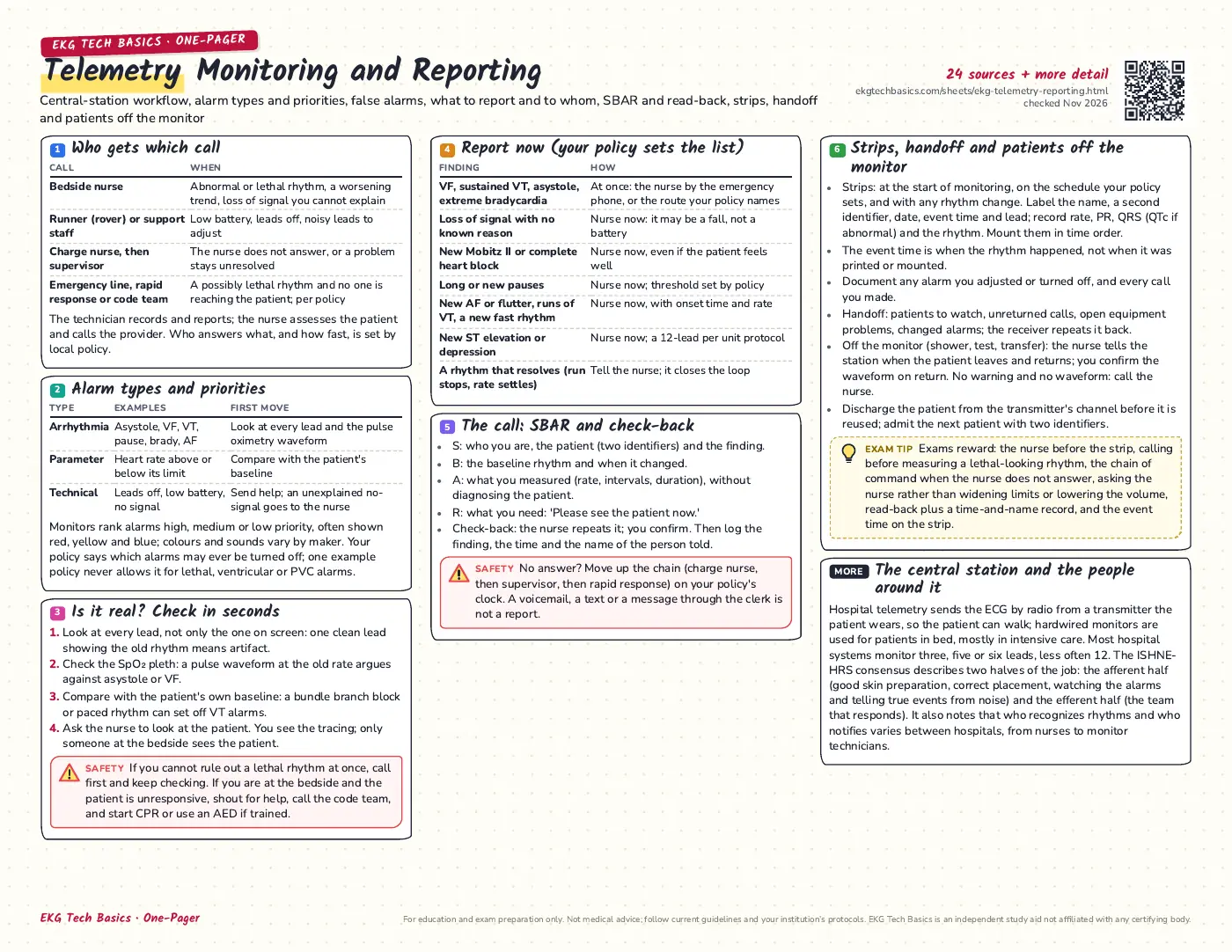
Who gets which call
| Call | When |
|---|---|
| Bedside nurse | Abnormal or lethal rhythm, a worsening trend, loss of signal you cannot explain |
| Runner (rover) or support staff | Low battery, leads off, noisy leads to adjust |
| Charge nurse, then supervisor | The nurse does not answer, or a problem stays unresolved |
| Emergency line, rapid response or code team | A possibly lethal rhythm and no one is reaching the patient; per policy |
The technician records and reports; the nurse assesses the patient and calls the provider. Who answers what, and how fast, is set by local policy.
Alarm types and priorities
| Type | Examples | First move |
|---|---|---|
| Arrhythmia | Asystole, VF, VT, pause, brady, AF | Look at every lead and the pulse oximetry waveform |
| Parameter | Heart rate above or below its limit | Compare with the patient's baseline |
| Technical | Leads off, low battery, no signal | Send help; an unexplained no-signal goes to the nurse |
Monitors rank alarms high, medium or low priority, often shown red, yellow and blue; colours and sounds vary by maker. Your policy says which alarms may ever be turned off; one example policy never allows it for lethal, ventricular or PVC alarms.
Is it real? Check in seconds
- Look at every lead, not only the one on screen: one clean lead showing the old rhythm means artifact.
- Check the SpO₂ pleth: a pulse waveform at the old rate argues against asystole or VF.
- Compare with the patient's own baseline: a bundle branch block or paced rhythm can set off VT alarms.
- Ask the nurse to look at the patient. You see the tracing; only someone at the bedside sees the patient.
Report now (your policy sets the list)
| Finding | How |
|---|---|
| VF, sustained VT, asystole, extreme bradycardia | At once: the nurse by the emergency phone, or the route your policy names |
| Loss of signal with no known reason | Nurse now: it may be a fall, not a battery |
| New Mobitz II or complete heart block | Nurse now, even if the patient feels well |
| Long or new pauses | Nurse now; threshold set by policy |
| New AF or flutter, runs of VT, a new fast rhythm | Nurse now, with onset time and rate |
| New ST elevation or depression | Nurse now; a 12-lead per unit protocol |
| A rhythm that resolves (run stops, rate settles) | Tell the nurse; it closes the loop |
The call: SBAR and check-back
- S: who you are, the patient (two identifiers) and the finding.
- B: the baseline rhythm and when it changed.
- A: what you measured (rate, intervals, duration), without diagnosing the patient.
- R: what you need: 'Please see the patient now.'
- Check-back: the nurse repeats it; you confirm. Then log the finding, the time and the name of the person told.
Strips, handoff and patients off the monitor
- Strips: at the start of monitoring, on the schedule your policy sets, and with any rhythm change. Label the name, a second identifier, date, event time and lead; record rate, PR, QRS (QTc if abnormal) and the rhythm. Mount them in time order.
- The event time is when the rhythm happened, not when it was printed or mounted.
- Document any alarm you adjusted or turned off, and every call you made.
- Handoff: patients to watch, unreturned calls, open equipment problems, changed alarms; the receiver repeats it back.
- Off the monitor (shower, test, transfer): the nurse tells the station when the patient leaves and returns; you confirm the waveform on return. No warning and no waveform: call the nurse.
- Discharge the patient from the transmitter's channel before it is reused; admit the next patient with two identifiers.
In depth
The one-page summary above is what the PDF prints. These sections go further.
The central station and the people around it
Hospital telemetry sends the ECG by radio from a transmitter the patient wears, so the patient can walk; hardwired monitors are used for patients in bed, mostly in intensive care. Most hospital systems monitor three, five or six leads, less often 12. The ISHNE-HRS consensus describes two halves of the job: the afferent half (good skin preparation, correct placement, watching the alarms and telling true events from noise) and the efferent half (the team that responds). It also notes that who recognizes rhythms and who notifies varies between hospitals, from nurses to monitor technicians.
Many hospitals now gather the screens in a central monitoring unit, in the hospital or off site. Published models give one technician about 30 to 50 patients; the Cleveland Clinic model ISHNE-HRS describes has one technician watching up to 48 patients, with lead technicians to help read complex rhythms, direct phones to the nurses and a crisis phone for emergencies. Mitchell 2026 lists the technician's duties: notify nursing promptly, capture strips accurately, review trends, validate and prioritize alarms, document, and keep closed-loop communication with the nurses. It also states the limit of the role: technicians collect data under the direction of the nurse and do not diagnose.
Context helps. One hospital asks nurses to tell the station when an antiarrhythmic is given by IV push, so the technician knows to watch (University of Toledo RCMS 1). The same guideline has the technician notify the nurse of rhythm changes and the nurse notify the physician.
Why most alarms are false
Monitor defaults are set to be very sensitive so that no real event is missed, and the price is poor specificity. ISHNE-HRS cites studies in which 72% to 99% of hospital alarms had no immediate clinical relevance. In Drew 2014, 461 ICU patients produced 2,558,760 alarms in 31 days: 1,154,201 arrhythmia, 612,927 parameter ('too high, too low') and 791,632 technical. Even with only the important ones made audible, there were 187 audible alarms per bed per day, and 88.8% of 12,671 annotated arrhythmia alarms were false.
| Alarm (Drew 2014) | False |
|---|---|
| Asystole | 67.0% |
| Ventricular fibrillation | 32.3% |
| Ventricular tachycardia | 86.8% |
| Accelerated ventricular rhythm | 94.8% |
| Pause | 87.7% |
| Ventricular bradycardia | 96.7% |
Alarm fatigue is the desensitization that follows: true events are missed when false ones have taught staff to tune out. ISHNE-HRS names the dangerous responses: making alarms inaudible, misusing alarm suspension, and changing limits just to silence them. What works: in the studies ISHNE-HRS cites, preparing the skin with fine sandpaper and changing electrodes daily cut alarms by 46%, and resetting default heart-rate limits to an upper 130–135 and lower 40–45 safely reduced alarms on a general ward. Alarm programs reviewed by Dee 2022 add education, policies, customizing limits to the patient and not monitoring patients who do not need it.
Who may set, change or turn off an alarm is a written policy: the Joint Commission requires hospitals to define it, along with clinically appropriate settings and checks of each alarm for accurate settings and detectability. Policies differ. At the University of Toledo the technician sets heart-rate limits at admission, about 20/min above and below the patient's baseline, may change them after talking with the nurse, may turn off non-lethal arrhythmia alarms, and never suspends lethal, ventricular-rhythm or PVC alarms. Elsewhere limits belong to the nurse and provider. Check alarm settings at the start of each shift, and document every change.
Verifying an alarm
Drew's team used a set of rules to call an alarm true or false, and they double as a technician's checklist. An asystole or VF alarm is false if a QRS is visible in any lead, if the patient's own complexes march through at the old rate, or if a good SpO₂ waveform keeps pulsing at the old rate. In 8 of 51 false VF alarms (16%), only one of seven leads was free of artifact, and that lead was often not on the central screen, so print or view all available leads at the alarm time.
- Low-voltage QRS in some leads makes the monitor undercount beats: false pause, asystole and bradycardia alarms. Choose a lead with tall QRS complexes.
- A wide QRS from bundle branch block or ventricular pacing sets off VT and accelerated ventricular rhythm alarms; P waves with a steady PR, or pacer spikes, give it away. Ask for pacer detection to be on for paced patients: in Drew's study only a third of paced patients had it on.
- Persistent AF triggers repeated alarms; Drew's team asks for AF alarms only at onset and end. Report a new onset, an end, or a rate outside the patient's limits, not every alarm.
- Brief ST 'spikes' set off ST alarms. The criterion Drew cites for transient ischemia is an ST change of 1 mm lasting at least a minute; 91% of the ST alarms in the study lasted less than a minute.
For the artifact patterns themselves (tremor, brushing teeth, loose electrodes, 60-cycle noise), see Artifact and Lead Problems; for what each rhythm looks like, see the Rhythm Gallery. Verification never replaces a person at the bedside: a technician sees a tracing, and a fall or a collapse can look like 'leads off'.
What to report, and how fast: two example policies
| Tier (University of Toledo, inpatient) | Findings |
|---|---|
| Emergency phone, at once | Sustained VT (over 10 s), VF, asystole, new sustained bradycardia under 30/min |
| Nurse by phone, at once | SVT, sinus and atrial tachycardia included, at 130/min or more for at least 1 minute; any change the technician thinks may be an emergency |
| Other red alarms | Within 10 minutes by phone |
| New yellow alarms | Within 30 minutes by phone |
| Off monitor, dead battery, poor signal | Nurse within 3–5 minutes, then the escalation chain |
| Tier (ISHNE-HRS example, ambulatory) | Findings |
|---|---|
| Emergency: physician now; EMS if not reached | Sustained regular wide-complex tachycardia at 160/min or more; prolonged asystole |
| Within 24 hours | Type II second-degree or third-degree AV block with or without symptoms; a pause of 4 s or more, sustained SVT 150/min or more, or bradycardia 30/min or less with symptoms; syncope; pacemaker malfunction; ICD shocks; sustained wide-complex tachycardia under 160/min |
| Office hours | New AF or flutter lasting 30 s or more; AF at 150/min or more for 60 s; wide runs at 120/min or more lasting 3 beats to 30 s; Mobitz I |
Why these rank high. Mobitz II fails suddenly in the His-Purkinje system and can progress to complete block or asystole without warning; LITFL puts the risk of asystole at about 35% a year. Complete heart block carries a high risk of ventricular standstill. VT is sustained when it lasts over 30 seconds or causes compromise needing intervention, and nonsustained when 3 or more ventricular beats stop on their own within 30 seconds. ST and T changes that appear or shift between tracings are dynamic and suggest ischemia. AF is called rapid once the ventricular rate is over 100. On a patient with a long QT, new PVCs and couplets may herald torsades (Drew 2014), so report them with the QT.
In a Holter or mobile telemetry lab the finding goes to the reading or on-call physician under the lab's protocol, not to the end of the scan. In the ISHNE-HRS example the service calls the patient only in an emergency, and calls EMS if the physician cannot be reached. For the full reading of each rhythm, see the Rhythm Gallery.
Escalation when the nurse does not answer
Every policy has a chain of command; the clocks differ. At the University of Toledo, if the nurse does not answer a sustained high-priority alarm the technician escalates at once to the charge nurse; for an off-monitor or signal problem it is the nurse, a second call after 10 minutes, the charge nurse after 10 more, then the unit director or house supervisor, with each call documented. A HealthTrust escalation sheet for lost signal runs faster: the nurse at once, the charge nurse after 2 minutes, the supervisor after 2 more, a rapid response after 1 more; it sends lethal rhythms straight to a rapid response.
Rapid response teams take calls from any staff member who sees a calling criterion. Typical criteria (AHRQ PSNet) include a heart rate over 140 or under 40/min, an acute change in mental status and a staff member's significant concern. The Joint Commission requires hospitals to write criteria for recognizing and responding to a change in a patient's condition, so the local list is the one to know.
If a concern is brushed aside, TeamSTEPPS' two-challenge rule applies: say it again, assertively, and make sure the other person acknowledges it; if the danger is still not addressed, take a stronger step, bring in other team members or use the chain of command.
SBAR, call-outs and check-backs
TeamSTEPPS defines SBAR as a way to pass critical information that needs immediate attention: Situation (what is going on), Background (the context), Assessment (what you think the problem is) and Recommendation or request (what should happen). For a technician the assessment is the measured finding, not a diagnosis of the patient. AHRQ PSNet notes that the evidence for SBAR alone is mixed; it helps most as part of a wider safety bundle.
Example: 'This is Sam at the central station about Maria Lopez, date of birth 4 June 1950, room 412. Just now, at 14:05, she went into a regular wide-complex rhythm at about 150, in both leads, and her pleth has gone flat. At 14:00 she was in sinus rhythm at 80. Please go to her now. I'm saving the strip.'
Closed-loop communication means the sender confirms the message was understood. A call-out informs the whole team at once and names who is to act; a check-back has the receiver repeat the message and the sender confirm it is correct. For critical results the Joint Commission requires written procedures that define what counts as critical, who reports to whom, and how fast.
Documenting calls, strips and alarm changes
- Each call: the finding, the time, who was told, and what happened next. Toledo's technicians note each call and to whom the message was given; HealthTrust's record every call on a worksheet.
- Routine strips: Toledo prints one every 12 hours (05:00 and 17:00), a baseline at admission and one with any significant change, labelled with date, time, room, telemetry number, name, heart rate, PR, QRS, the interpretation and the QTc if abnormal, on an arrhythmia flow sheet that becomes part of the permanent chart. Southern Health mounts one at the start of monitoring, each shift and with any new rhythm, and charts rate and rhythm every 4 hours.
- Toledo flags a PR over 0.20 s as first-degree AV block and a QRS over 0.11 s as an intraventricular conduction delay on routine strips.
- Identifiers: the Joint Commission requires at least two, and a room number is not one. Use the name and a date of birth or record number; the room and transmitter number are extra labels.
- Time: record a finding with the time it happened. A stored event printed at 05:40 that occurred at 03:12 is dated 03:12. An entry made late says 'late entry' with the time the care or finding occurred, and also carries the time you write it.
- Corrections stay visible: a single line and initials on paper, an added note in the electronic record. Chart under your own login and never share it.
- End of shift: Toledo's technicians trend each patient's ectopy and heart rate and keep a report sheet of events, VT runs, rate changes, discharges and transfers.
At a cardiac arrest the technician may be named recorder. Normally each person documents only their own care and co-signing is not allowed; Lapum et al. name the designated code recorder as the exception, so the recorder writes down the team's actions and their times as they happen.
Handoff between technicians
A handoff transfers information along with authority and responsibility. TeamSTEPPS lists its parts: transfer of responsibility and accountability, clear information, said aloud, acknowledged by the receiver, with a chance to ask questions. The Joint Commission requires a handoff process that allows that discussion. I-PASS, the tool TeamSTEPPS prefers, runs Illness severity (stable, watcher, unstable), Patient summary, Action list, Situation awareness and contingency plans ('if this happens, do that'), and Synthesis by the receiver. PSNet adds that handoffs need a setting free of interruptions.
- Watchers: who is new, who changed rhythm, who had runs or pauses, and what the nurse was told.
- Open loops: calls not returned, escalations in progress, strips still to be mounted.
- Equipment: patients off the monitor and why, low batteries, noisy channels sent to a runner.
- Alarm changes: any limit adjusted or alarm turned off this shift, and who agreed to it.
- Then walk the screens together and let the receiver read it back.
Patients leaving and returning to the monitor
Every policy opened ties the station and the unit together for departures. Toledo keeps alarms on at all times except for bathing or a patient off the floor; the nurse tells the station when the patient leaves and returns, the alarms go back on as soon as the waveform reappears, and if the waveform vanishes without notice the technician calls the nurse. HealthTrust asks nurses to tell the station about showers, room changes and trips off the unit and to confirm the patient is back on the monitor afterwards. Southern Health reminds staff that a move to imaging or a lab causes a sudden loss of information at the station, and that the signal is not captured once the patient leaves the building.
Who goes with a monitored patient off the unit, and on what monitor, is local policy. Being off telemetry is a real risk: ISHNE-HRS cites a study in which 20% of cardiac arrests outside the ICU happened in unmonitored patients.
- Starting monitoring: an order, a transmitter assigned to the patient, admission to the central station with two identifiers, a baseline strip, and limits set per policy.
- Ending monitoring: an order to discontinue. Discharge the patient from the central station, document it, and clean the transmitter before it goes back. Discharge from the channel first, or the next patient's rhythm appears under this patient's name.
- Review: Mitchell 2026 asks technicians to flag patients whose reason for telemetry has resolved; Toledo reviews every patient at 72 hours and tells the charge nurse, who asks the physician.
Exam pearls
- Three alerts at once: the patient change (a sudden rate drop on a clean tracing) before the battery and the leads-off.
- Unexplained no-signal: the nurse checks the patient now; do not assume the patient walked out of range.
- Wide fast rhythm, two leads agree, flat pleth: call first; the strip and the measurements come after.
- Nurse does not answer: charge nurse next; an emergency rhythm with no answer: the emergency line per protocol.
- Repeated rate alarms in known AF: ask the nurse to review the limits under policy; never lower the volume.
- Runner swapped a battery: confirm with the station that a clean waveform is back.
- Mobitz II or complete block, even with no symptoms: report now. Mobitz I: document it and report it on the less urgent schedule your policy sets.
- The strip shows the event time; the record shows the time, the finding and the name of the person who read it back.
Related cheat sheets
- Safety, Compliance and Patient CarePatient ID, consent, HIPAA, infection control, electrical safety, vital signs, recognizing and reporting emergencies, CPR and AED, safe lifting, scope and charting for EKG technicians
- Electrode and Lead PlacementLimb and chest landmarks, counting from the angle of Louis, telemetry and Mason-Likar layouts, right-sided, posterior and 15-lead recordings, children, amputations, dextrocardia, and what to write when placement is not standard
- Artifact and Lead ProblemsTremor, 60-cycle interference, wandering baseline, loose electrodes, lead-off and cable faults, artifact that mimics VT, VF or a pause, and limb and chest lead reversals
- Paper, Settings and MeasurementThe grid, paper speed, gain and the calibration pulse, filters, heart rate methods, PR, QRS and QT in adults and children, QTc formulas and U waves
- Analyzing a Rhythm Strip Step by StepA fixed order for every strip, regularity, narrow vs wide fast rhythms, early vs escape beats, describing what you cannot name, and what to report at once
- AV Blocks, Bundle Branch Blocks and Pre-excitationCriteria tables for every degree of AV block, AV dissociation, bundle branch and fascicular blocks, and WPW, with what to measure and when to report
Sources
- Steinberg JS, Varma N, Cygankiewicz I, et al. 2017 ISHNE-HRS expert consensus statement on ambulatory ECG and external cardiac monitoring/telemetry. Ann Noninvasive Electrocardiol. 2017;22(3):e12447. doi:10.1111/anec.12447 Link
- Mitchell K, Lopez V, Lopez L, Policicchio B, Turmell J, Ríos R. Strengthening Telemetry Safety Through Standardized Physiological Parameter Monitor Technician Education: A Practice-Based Framework. J Patient Saf. 2026;22(6):e183-e188. doi:10.1097/PTS.0000000000001550 Link
- Drew BJ, Harris P, Zègre-Hemsey JK, et al. Insights into the problem of alarm fatigue with physiologic monitor devices: a comprehensive observational study of consecutive intensive care unit patients. PLoS One. 2014;9(10):e110274. doi:10.1371/journal.pone.0110274 Link
- Dee SA, Tucciarone J, Plotkin G, Mallilo C. Determining the Impact of an Alarm Management Program on Alarm Fatigue among ICU and Telemetry RNs: An Evidence Based Research Project. SAGE Open Nurs. 2022;8:23779608221098713. doi:10.1177/23779608221098713 Link
- Hunn C, Nöthiger CB, Braun J, et al. User-Centered Redesign of Monitoring Alarms: A Pre-Post Study on Perception, Functionality, and Recognizability Following Real-Life Clinical Implementation. Healthcare (Basel). 2025;13(23):3033. doi:10.3390/healthcare13233033 Link
- Sandau KE, Funk M, Auerbach A, et al. Update to Practice Standards for Electrocardiographic Monitoring in Hospital Settings: A Scientific Statement From the American Heart Association. Circulation. 2017;136(19):e273-e344. doi:10.1161/CIR.0000000000000527 (abstract only) Link
- The Joint Commission. National Performance Goals, Effective January 2026 for the Hospital Program (NPG.01.01.01, NPG.01.02.01, NPG.01.04.01, NPG.01.05.01 to NPG.01.05.03). 2025. Link
- Agency for Healthcare Research and Quality. TeamSTEPPS 3.0 Pocket Guide: Team Strategies and Tools to Enhance Performance and Patient Safety. AHRQ Pub. No. 23-0043. Revised May 2023. Link
- Agency for Healthcare Research and Quality. Handoffs and Signouts. PSNet Patient Safety Primer. Last reviewed 2024. Link
- Agency for Healthcare Research and Quality. Rapid Response Systems. PSNet Patient Safety Primer. Last reviewed September 15, 2024. Link
- Burns E, Buttner R. AV Block: 2nd degree, Mobitz II (Hay block). LITFL ECG Library. Link
- Burns E, Buttner R. AV Block: 3rd degree (complete heart block). LITFL ECG Library. Link
- Burns E, Buttner R. Ventricular Tachycardia: Monomorphic VT. LITFL ECG Library. Link
- Burns E, Buttner R. Myocardial Ischaemia. LITFL ECG Library. Link
- Burns E, Buttner R. Atrial Fibrillation. LITFL ECG Library. Link
- Lapum J, St-Amant O, Ronquillo C, Hughes M, Garmaise-Yee J. Principles of Documentation. In: Documentation in Nursing, 1st Canadian edition. Toronto Metropolitan University Pressbooks; 2020 (updated 2026). Link
- University of Toledo Medical Center, Remote Cardiac Monitoring Station. Guideline RCMS 1: Telemetry Cardiac Monitoring Functions. Effective 2/2025 (example of local policy). Link
- University of Toledo Medical Center, Remote Cardiac Monitoring Station. Guideline RCMS 3: Remote Cardiac Monitoring Daily Activities. Effective 2/2025 (example of local policy). Link
- University of Toledo Medical Center, Remote Cardiac Monitoring Station. Guideline RCMS 4: Specific RCMS Functions. Effective 2/2025 (example of local policy). Link
- University of Toledo Medical Center, Remote Cardiac Monitoring Station. Guideline RCMS 5: Notifications of Nursing Personnel by RCMS of Telemetry Issues and Patient Arrhythmias. Effective 2/2025 (example of local policy). Link
- University of Toledo Medical Center, Remote Cardiac Monitoring Station. Guideline RCMS 6: Alarm Parameters in the RCMS. Effective 2/2025 (example of local policy). Link
- Southern Health-Santé Sud. Inpatient Telemetry. Standard Guideline CLI.4510.SG.007. Issued August 28, 2023 (example of local policy). Link
- HealthTrust Clinical Operations. Monitor Tech and Telemetry Information for the Nursing Floors: Escalation Protocol. September 24, 2020 (example of local policy). Link
- National Healthcareer Association. Certified EKG Technician (CET) Test Plan (2017 job analysis). Link