 EKG Tech Basics
Exam guide
CCI CRAT Exam Guide
The Certified Rhythm Analysis Technician exam: format, item types, scoring, eligibility, the content matrix and a 6-week study plan
Practice CCI CRAT questions free
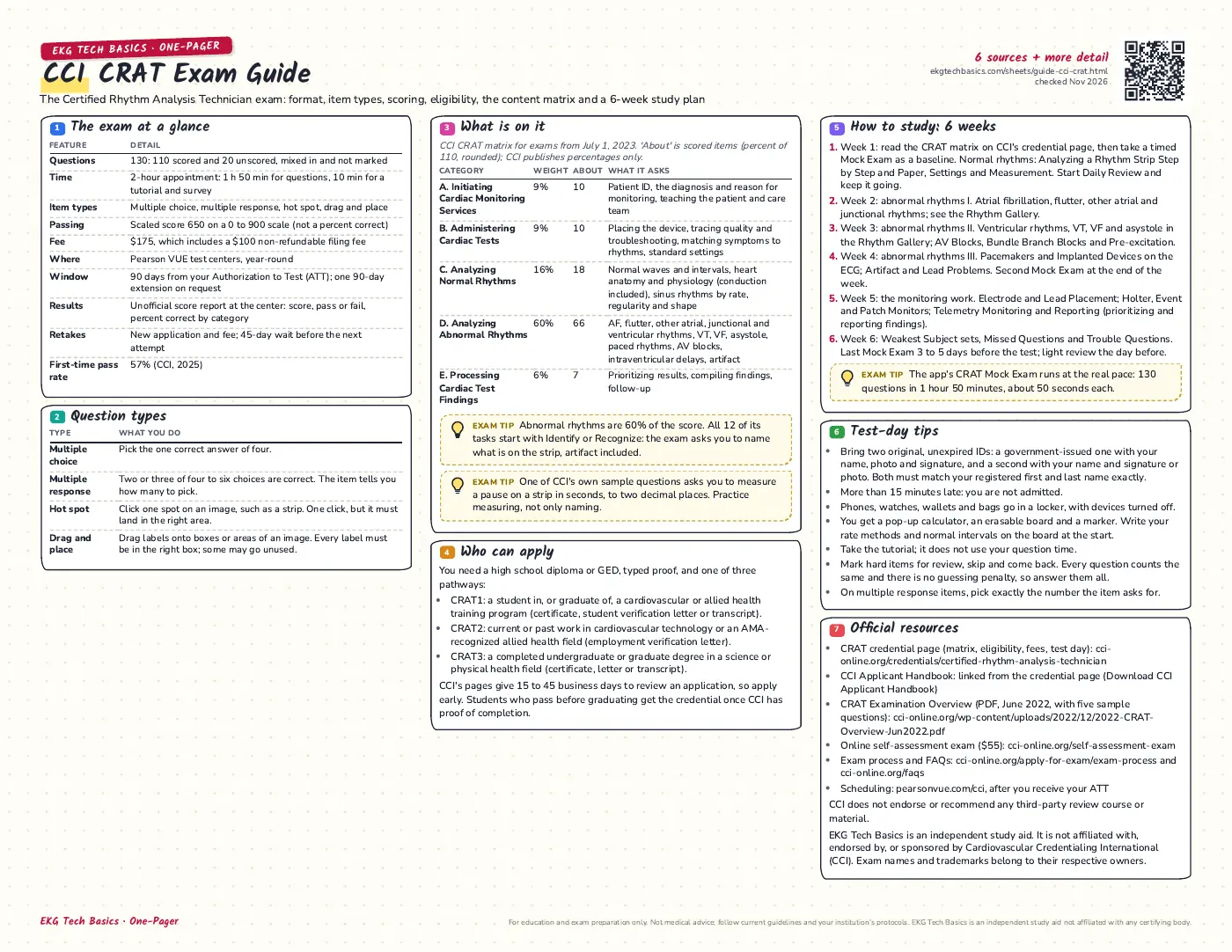
The exam at a glance
| Feature | Detail |
|---|---|
| Questions | 130: 110 scored and 20 unscored, mixed in and not marked |
| Time | 2-hour appointment: 1 h 50 min for questions, 10 min for a tutorial and survey |
| Item types | Multiple choice, multiple response, hot spot, drag and place |
| Passing | Scaled score 650 on a 0 to 900 scale (not a percent correct) |
| Fee | $175, which includes a $100 non-refundable filing fee |
| Where | Pearson VUE test centers, year-round |
| Window | 90 days from your Authorization to Test (ATT); one 90-day extension on request |
| Results | Unofficial score report at the center: score, pass or fail, percent correct by category |
| Retakes | New application and fee; 45-day wait before the next attempt |
| First-time pass rate | 57% (CCI, 2025) |
Question types
| Type | What you do |
|---|---|
| Multiple choice | Pick the one correct answer of four. |
| Multiple response | Two or three of four to six choices are correct. The item tells you how many to pick. |
| Hot spot | Click one spot on an image, such as a strip. One click, but it must land in the right area. |
| Drag and place | Drag labels onto boxes or areas of an image. Every label must be in the right box; some may go unused. |
What is on it
| Category | Weight | About | What it asks |
|---|---|---|---|
| A. Initiating Cardiac Monitoring Services | 9% | 10 | Patient ID, the diagnosis and reason for monitoring, teaching the patient and care team |
| B. Administering Cardiac Tests | 9% | 10 | Placing the device, tracing quality and troubleshooting, matching symptoms to rhythms, standard settings |
| C. Analyzing Normal Rhythms | 16% | 18 | Normal waves and intervals, heart anatomy and physiology (conduction included), sinus rhythms by rate, regularity and shape |
| D. Analyzing Abnormal Rhythms | 60% | 66 | AF, flutter, other atrial, junctional and ventricular rhythms, VT, VF, asystole, paced rhythms, AV blocks, intraventricular delays, artifact |
| E. Processing Cardiac Test Findings | 6% | 7 | Prioritizing results, compiling findings, follow-up |
Who can apply
You need a high school diploma or GED, typed proof, and one of three pathways:
- CRAT1: a student in, or graduate of, a cardiovascular or allied health training program (certificate, student verification letter or transcript).
- CRAT2: current or past work in cardiovascular technology or an AMA-recognized allied health field (employment verification letter).
- CRAT3: a completed undergraduate or graduate degree in a science or physical health field (certificate, letter or transcript).
CCI's pages give 15 to 45 business days to review an application, so apply early. Students who pass before graduating get the credential once CCI has proof of completion.
How to study: 6 weeks
- Week 1: read the CRAT matrix on CCI's credential page, then take a timed Mock Exam as a baseline. Normal rhythms: Analyzing a Rhythm Strip Step by Step and Paper, Settings and Measurement. Start Daily Review and keep it going.
- Week 2: abnormal rhythms I. Atrial fibrillation, flutter, other atrial and junctional rhythms; see the Rhythm Gallery.
- Week 3: abnormal rhythms II. Ventricular rhythms, VT, VF and asystole in the Rhythm Gallery; AV Blocks, Bundle Branch Blocks and Pre-excitation.
- Week 4: abnormal rhythms III. Pacemakers and Implanted Devices on the ECG; Artifact and Lead Problems. Second Mock Exam at the end of the week.
- Week 5: the monitoring work. Electrode and Lead Placement; Holter, Event and Patch Monitors; Telemetry Monitoring and Reporting (prioritizing and reporting findings).
- Week 6: Weakest Subject sets, Missed Questions and Trouble Questions. Last Mock Exam 3 to 5 days before the test; light review the day before.
Test-day tips
- Bring two original, unexpired IDs: a government-issued one with your name, photo and signature, and a second with your name and signature or photo. Both must match your registered first and last name exactly.
- More than 15 minutes late: you are not admitted.
- Phones, watches, wallets and bags go in a locker, with devices turned off.
- You get a pop-up calculator, an erasable board and a marker. Write your rate methods and normal intervals on the board at the start.
- Take the tutorial; it does not use your question time.
- Mark hard items for review, skip and come back. Every question counts the same and there is no guessing penalty, so answer them all.
- On multiple response items, pick exactly the number the item asks for.
Official resources
- CRAT credential page (matrix, eligibility, fees, test day): cci-online.org/credentials/certified-rhythm-analysis-technician
- CCI Applicant Handbook: linked from the credential page (Download CCI Applicant Handbook)
- CRAT Examination Overview (PDF, June 2022, with five sample questions): cci-online.org/wp-content/uploads/2022/12/2022-CRAT-Overview-Jun2022.pdf
- Online self-assessment exam ($55): cci-online.org/self-assessment-exam
- Exam process and FAQs: cci-online.org/apply-for-exam/exam-process and cci-online.org/faqs
- Scheduling: pearsonvue.com/cci, after you receive your ATT
CCI does not endorse or recommend any third-party review course or material.
EKG Tech Basics is an independent study aid. It is not affiliated with, endorsed by, or sponsored by Cardiovascular Credentialing International (CCI). Exam names and trademarks belong to their respective owners.
In depth
The one-page summary above is what the PDF prints. These sections go further.
The task list, and where the app teaches it
CCI links every exam question to one task in its CRAT task list. The list below is CCI's, in plain words, with the Reference pages that cover each part.
| Category | CCI tasks | Where to study |
|---|---|---|
| A. Initiating Cardiac Monitoring Services (9%) | Verify patient identification. Review the diagnosis, history or reason for monitoring. Teach the patient or care team about the service, the device, its placement, safety and care. | Holter, Event and Patch Monitors; Telemetry Monitoring and Reporting |
| B. Administering Cardiac Tests (9%) | Place the monitoring device. Judge ECG quality: reduce interference and troubleshoot. Match patient symptoms to events or rhythms. Recognize standard ECG settings. | Electrode and Lead Placement; Artifact and Lead Problems; Paper, Settings and Measurement; Holter, Event and Patch Monitors |
| C. Analyzing Normal Rhythms (16%) | Identify normal ECG components. Identify cardiac anatomy and physiology. Link waveform shape to anatomy and physiology. Identify sinus rhythms, rates, regularity and wave shape. | Analyzing a Rhythm Strip Step by Step; Paper, Settings and Measurement; Rhythm Gallery |
| D. Analyzing Abnormal Rhythms (60%) | Identify atrial fibrillation, atrial flutter, other atrial, junctional and ventricular arrhythmias, asystole, ventricular tachycardia, ventricular fibrillation, paced rhythms, intraventricular conduction delays and AV conduction defects. Recognize artifact. | Rhythm Gallery; AV Blocks, Bundle Branch Blocks and Pre-excitation; Pacemakers and Implanted Devices on the ECG; Artifact and Lead Problems |
| E. Processing Cardiac Test Findings (6%) | Prioritize ECG results. Compile test findings. Carry out follow-up. | Telemetry Monitoring and Reporting; Holter, Event and Patch Monitors |
CCI's knowledge list adds the background those tasks rest on: regulatory and compliance standards (for example OSHA, HIPAA, informed consent and medical records), medical ethics, communication with patients and staff, patient safety, emergency response, basic cardiovascular anatomy and physiology, rhythm analysis, ECG troubleshooting, documentation and medical terminology.
Applying and scheduling
- Create or sign in to your CCI online account and choose the CRAT application. The qualification pathway tool on the credential page helps you pick CRAT1, CRAT2 or CRAT3.
- Enter your education and work history, upload a copy of an unexpired government-issued photo ID and your typed proof as PDFs, and pay the $175 fee (check, money order or a major credit card; no cash).
- Wait for review. An incomplete application is not approved; you have 60 days to fix it, or CCI refunds the fee minus the $100 filing fee.
- When CCI approves you, it emails an Authorization to Test (ATT). Your 90-day window opens then.
- Schedule through the Pearson VUE dashboard in your CCI account, or at pearsonvue.com/cci.
- To reschedule, do it in the Pearson VUE dashboard at least two full business days before the appointment. Later than that, you cannot reschedule.
- Extension: one per exam, for 90 days, requested in your CCI account before the first window ends. If you have already booked with Pearson VUE, cancel that appointment first.
- Refunds: the $100 filing fee is never refunded. Not showing up forfeits the whole fee.
- Emergencies (death of an immediate family member, a serious illness or injury needing hospital care, or another event causing emotional distress): CCI may let you reschedule without penalty if you send written proof within 3 days of the exam date.
- Accommodations for a documented disability: request them in writing with the application, with a letter from a qualified evaluator, and again with every re-examination.
- Criminal history: CCI offers a $50 pre-application review if you have a misdemeanor or felony conviction, guilty plea or no-contest plea.
After the exam: scores, retakes and keeping the credential
- Score: only the 110 scored items count. The scaled score runs from 0 to 900, 650 passes, and the number of correct answers needed for 650 comes from a standard-setting study. The scaled score is not the number or percent of questions you got right.
- Official results: if you pass, CCI sends a results letter, certificate and wallet card about 15 business days after the exam (the handbook says about 20).
- Score verification: $50, by written request. It rechecks the computer's count, not the questions.
- Retake: complete a new application and pay the fee again. You may reapply the day after testing, but you must wait 45 days before sitting the exam again. Supporting documents sent within the last two years need not be sent again if they still meet the requirements.
- Use your category percentages to plan the retake: start with the lowest category that also carries the most weight.
| Renewal step | What CCI requires |
|---|---|
| First renewal | 9 to 12 months after passing, by the date on your wallet card: $165 and a signed Code of Ethics; no CEUs |
| Every 3 years after that | $165, a signed Code of Ethics and 16 CEUs in any medical-related field |
CCI's self-assessment exam
- It is CCI's own online practice exam and costs $55. Its sample items follow the proportions of the exam matrix.
- You can take it once per purchase. You have a year to start it and 72 hours to finish once you start.
- The result is your percent correct in each content category. It does not show the questions, your answers or why an answer was wrong.
- CCI says the result does not predict a pass and that it should not be your only preparation.
Sources
- Cardiovascular Credentialing International. Certified Rhythm Analysis Technician (CRAT): qualification requirements, exam preparation and matrix (as of July 1, 2023), approved test taker, exam day and maintaining credentials. Accessed November 15, 2026. Link
- Cardiovascular Credentialing International. Examination Overview: Certified Rhythm Analysis Technician (CRAT). Publication date June 2022. Link
- Cardiovascular Credentialing International. CCI Applicant Handbook. Publication date January 2024 (file named Dec2022). Accessed November 15, 2026. Link
- Cardiovascular Credentialing International. Exam process. Accessed November 15, 2026. Link
- Cardiovascular Credentialing International. Frequently asked questions (applications, testing, 2025 pass rates, retesting, refunds, renewal). Accessed November 15, 2026. Link
- Cardiovascular Credentialing International. Self-Assessment Exam. Accessed November 15, 2026. Link