 EKG Tech Basics
Exam guide
NHA CET Exam Guide
Format, scoring, eligibility, the 2017 test plan in use now and the 2026 plan coming in late 2027 or winter 2027-28, and a 6-week study plan
Practice NHA CET questions free
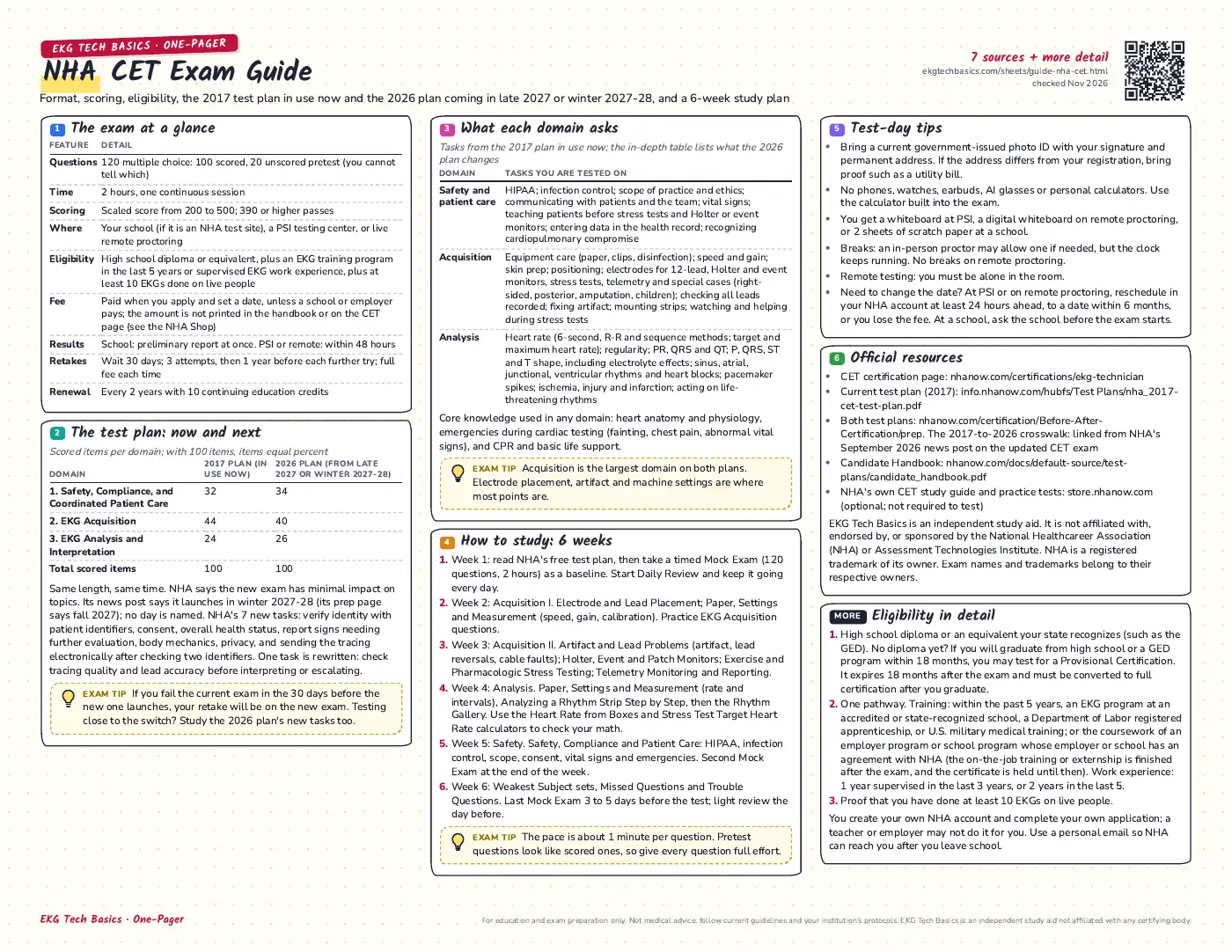
The exam at a glance
| Feature | Detail |
|---|---|
| Questions | 120 multiple choice: 100 scored, 20 unscored pretest (you cannot tell which) |
| Time | 2 hours, one continuous session |
| Scoring | Scaled score from 200 to 500; 390 or higher passes |
| Where | Your school (if it is an NHA test site), a PSI testing center, or live remote proctoring |
| Eligibility | High school diploma or equivalent, plus an EKG training program in the last 5 years or supervised EKG work experience, plus at least 10 EKGs done on live people |
| Fee | Paid when you apply and set a date, unless a school or employer pays; the amount is not printed in the handbook or on the CET page (see the NHA Shop) |
| Results | School: preliminary report at once. PSI or remote: within 48 hours |
| Retakes | Wait 30 days; 3 attempts, then 1 year before each further try; full fee each time |
| Renewal | Every 2 years with 10 continuing education credits |
The test plan: now and next
| Domain | 2017 plan (in use now) | 2026 plan (from late 2027 or winter 2027-28) |
|---|---|---|
| 1. Safety, Compliance, and Coordinated Patient Care | 32 | 34 |
| 2. EKG Acquisition | 44 | 40 |
| 3. EKG Analysis and Interpretation | 24 | 26 |
| Total scored items | 100 | 100 |
Same length, same time. NHA says the new exam has minimal impact on topics. Its news post says it launches in winter 2027-28 (its prep page says fall 2027); no day is named. NHA's 7 new tasks: verify identity with patient identifiers, consent, overall health status, report signs needing further evaluation, body mechanics, privacy, and sending the tracing electronically after checking two identifiers. One task is rewritten: check tracing quality and lead accuracy before interpreting or escalating.
What each domain asks
| Domain | Tasks you are tested on |
|---|---|
| Safety and patient care | HIPAA; infection control; scope of practice and ethics; communicating with patients and the team; vital signs; teaching patients before stress tests and Holter or event monitors; entering data in the health record; recognizing cardiopulmonary compromise |
| Acquisition | Equipment care (paper, clips, disinfection); speed and gain; skin prep; positioning; electrodes for 12-lead, Holter and event monitors, stress tests, telemetry and special cases (right-sided, posterior, amputation, children); checking all leads recorded; fixing artifact; mounting strips; watching and helping during stress tests |
| Analysis | Heart rate (6-second, R-R and sequence methods; target and maximum heart rate); regularity; PR, QRS and QT; P, QRS, ST and T shape, including electrolyte effects; sinus, atrial, junctional, ventricular rhythms and heart blocks; pacemaker spikes; ischemia, injury and infarction; acting on life-threatening rhythms |
Core knowledge used in any domain: heart anatomy and physiology, emergencies during cardiac testing (fainting, chest pain, abnormal vital signs), and CPR and basic life support.
How to study: 6 weeks
- Week 1: read NHA's free test plan, then take a timed Mock Exam (120 questions, 2 hours) as a baseline. Start Daily Review and keep it going every day.
- Week 2: Acquisition I. Electrode and Lead Placement; Paper, Settings and Measurement (speed, gain, calibration). Practice EKG Acquisition questions.
- Week 3: Acquisition II. Artifact and Lead Problems (artifact, lead reversals, cable faults); Holter, Event and Patch Monitors; Exercise and Pharmacologic Stress Testing; Telemetry Monitoring and Reporting.
- Week 4: Analysis. Paper, Settings and Measurement (rate and intervals), Analyzing a Rhythm Strip Step by Step, then the Rhythm Gallery. Use the Heart Rate from Boxes and Stress Test Target Heart Rate calculators to check your math.
- Week 5: Safety. Safety, Compliance and Patient Care: HIPAA, infection control, scope, consent, vital signs and emergencies. Second Mock Exam at the end of the week.
- Week 6: Weakest Subject sets, Missed Questions and Trouble Questions. Last Mock Exam 3 to 5 days before the test; light review the day before.
Test-day tips
- Bring a current government-issued photo ID with your signature and permanent address. If the address differs from your registration, bring proof such as a utility bill.
- No phones, watches, earbuds, AI glasses or personal calculators. Use the calculator built into the exam.
- You get a whiteboard at PSI, a digital whiteboard on remote proctoring, or 2 sheets of scratch paper at a school.
- Breaks: an in-person proctor may allow one if needed, but the clock keeps running. No breaks on remote proctoring.
- Remote testing: you must be alone in the room.
- Need to change the date? At PSI or on remote proctoring, reschedule in your NHA account at least 24 hours ahead, to a date within 6 months, or you lose the fee. At a school, ask the school before the exam starts.
Official resources
- CET certification page: nhanow.com/certifications/ekg-technician
- Current test plan (2017): info.nhanow.com/hubfs/Test Plans/nha_2017-cet-test-plan.pdf
- Both test plans: nhanow.com/certification/Before-After-Certification/prep. The 2017-to-2026 crosswalk: linked from NHA's September 2026 news post on the updated CET exam
- Candidate Handbook: nhanow.com/docs/default-source/test-plans/candidate_handbook.pdf
- NHA's own CET study guide and practice tests: store.nhanow.com (optional; not required to test)
EKG Tech Basics is an independent study aid. It is not affiliated with, endorsed by, or sponsored by the National Healthcareer Association (NHA) or Assessment Technologies Institute. NHA is a registered trademark of its owner. Exam names and trademarks belong to their respective owners.
In depth
The one-page summary above is what the PDF prints. These sections go further.
Every change from the 2017 to the 2026 plan
| Area | 2017 plan | 2026 plan |
|---|---|---|
| Infection control | OSHA, universal precautions | Standard and transmission-based precautions |
| Communication | Patients and the team | Adds families and caregivers; teaching methods such as demonstration, teach-back and pamphlets |
| Identity and consent | Not a task | New: greet the patient, verify identity with identifiers (name, date of birth, wristband or QR code); obtain and document implied or informed (verbal or written) consent |
| Health status and vital signs | Obtain and interpret vital signs | Measure and assess vital signs (typical and atypical across the lifespan); new: assess overall health status |
| Reporting | Recognize cardiopulmonary compromise | New (on NHA's list): report signs needing further evaluation (cardiopulmonary compromise, altered mental status, sweating); signs of low cardiac output and distress |
| Patient teaching | Separate tasks for stress tests and ambulatory monitors | One task: pre-test protocols for both, and confirm understanding; adds precautions for EKG and contraindications for stress testing |
| Body mechanics | Not a task | New: proper body mechanics when moving or lifting patients |
| Equipment and settings | Maintain equipment; verify speed and gain | Disinfect or sterilize; verify equipment function, calibration, speed, gain and lead selection |
| Privacy and positioning | Position for 3-, 5-, 12-lead, stress test, telemetry | New: ensure privacy and explain removing clothing or accessories; positions named as supine, semi-Fowler's, prone |
| Skin prep and electrodes | Prepare skin; apply electrodes | Prep includes addressing factors that cause artifact (methods named: alcohol, prep gel, abrasion, hair clipping); review the provider's order and use anatomical landmarks |
| Special cases | Right-sided, posterior, amputation, pediatric | Dextrocardia, posterior, amputation, pediatric, pacemaker; purpose of diagnostic EKGs versus continuous telemetry |
| Charting the tracing | Mount the strip | New: send the tracing electronically after verifying two patient identifiers; mount only if a paper system is used |
| Stress testing | Monitor and support during complications | Same tasks; adds risks such as falls and cardiac arrest, and EKG changes as an adverse sign |
| Tracing quality | Inspect P, QRS, ST and T for symmetry, direction and amplitude | Rewritten: verify tracing quality and lead accuracy before interpreting or escalating; waveform characteristics stay in the knowledge list |
| Rate and measurement | 6-second, R-R, sequencing | 6-second, R-R, 1500 method; time and amplitude calibration of the paper |
| Rhythms and patterns | Arrhythmias; ischemia, injury and infarction; pacemaker spikes | Adds asystole to life-threatening examples; atrial-paced, ventricular-paced and dual-chamber spikes; bundle branch patterns; report ischemia findings by protocol; escalation protocols |
NHA's crosswalk marks every new task as content students already learn for the current exam. When a new test plan's first form comes out, NHA may hold scores briefly (pilot scoring) while it sets the cut score.
Eligibility in detail
- High school diploma or an equivalent your state recognizes (such as the GED). No diploma yet? If you will graduate from high school or a GED program within 18 months, you may test for a Provisional Certification. It expires 18 months after the exam and must be converted to full certification after you graduate.
- One pathway. Training: within the past 5 years, an EKG program at an accredited or state-recognized school, a Department of Labor registered apprenticeship, or U.S. military medical training; or the coursework of an employer program or school program whose employer or school has an agreement with NHA (the on-the-job training or externship is finished after the exam, and the certificate is held until then). Work experience: 1 year supervised in the last 3 years, or 2 years in the last 5.
- Proof that you have done at least 10 EKGs on live people.
You create your own NHA account and complete your own application; a teacher or employer may not do it for you. Use a personal email so NHA can reach you after you leave school.
Scores, retakes and renewal
| Topic | What NHA says |
|---|---|
| Scaled score | Each form is weighted for difficulty so that 390 means the same on every form |
| Score report | Pass or fail, the score, and each domain rated Above, Near or Below the passing standard |
| Reading 'Near' | Near is not a safe result; study Near and Below domains first, but do not drop Above domains |
| Rescoring | Written request within 60 days of the exam; NHA may charge a fee |
| Retakes | 30 days between attempts; after a third failed attempt, wait 1 year before each further try; re-register and pay the full fee each time |
| Accommodations | Apply with the NHA form and documentation; allow 30 days for review. Extra time is 150% of the standard time unless your documentation shows more is needed |
| Renewal | Every 2 years: 10 CE credits (2 hours of a qualified program equals 1 credit) and a renewal fee; a 1-month grace period; reinstate within 1 year of expiring with 15 CE credits and fees, or retest after that |
Sources
- National Healthcareer Association. NHA Certified EKG Technician (CET) Test Plan for the CET Exam, based on the 2017 job analysis. Link
- National Healthcareer Association. NHA Certified EKG Technician (CET) Test Plan for the CET Exam, based on the 2026 job analysis. Link
- National Healthcareer Association. CET Crosswalk 2017 to 2026. Link
- National Healthcareer Association. Updated CET Certification Exam & Study Materials Coming in 2027/28 (media center, September 2026). Link
- National Healthcareer Association. Candidate Handbook, updated 10/05/2026 (copyright Assessment Technologies Institute). Link
- National Healthcareer Association. Certified EKG Technician (CET) certification page. Accessed November 15, 2026. Link
- National Healthcareer Association. Study for your NHA exam (test plans and study materials). Accessed November 15, 2026. Link