 EKG Tech Basics
Exam guide
CCI CCT Exam Guide
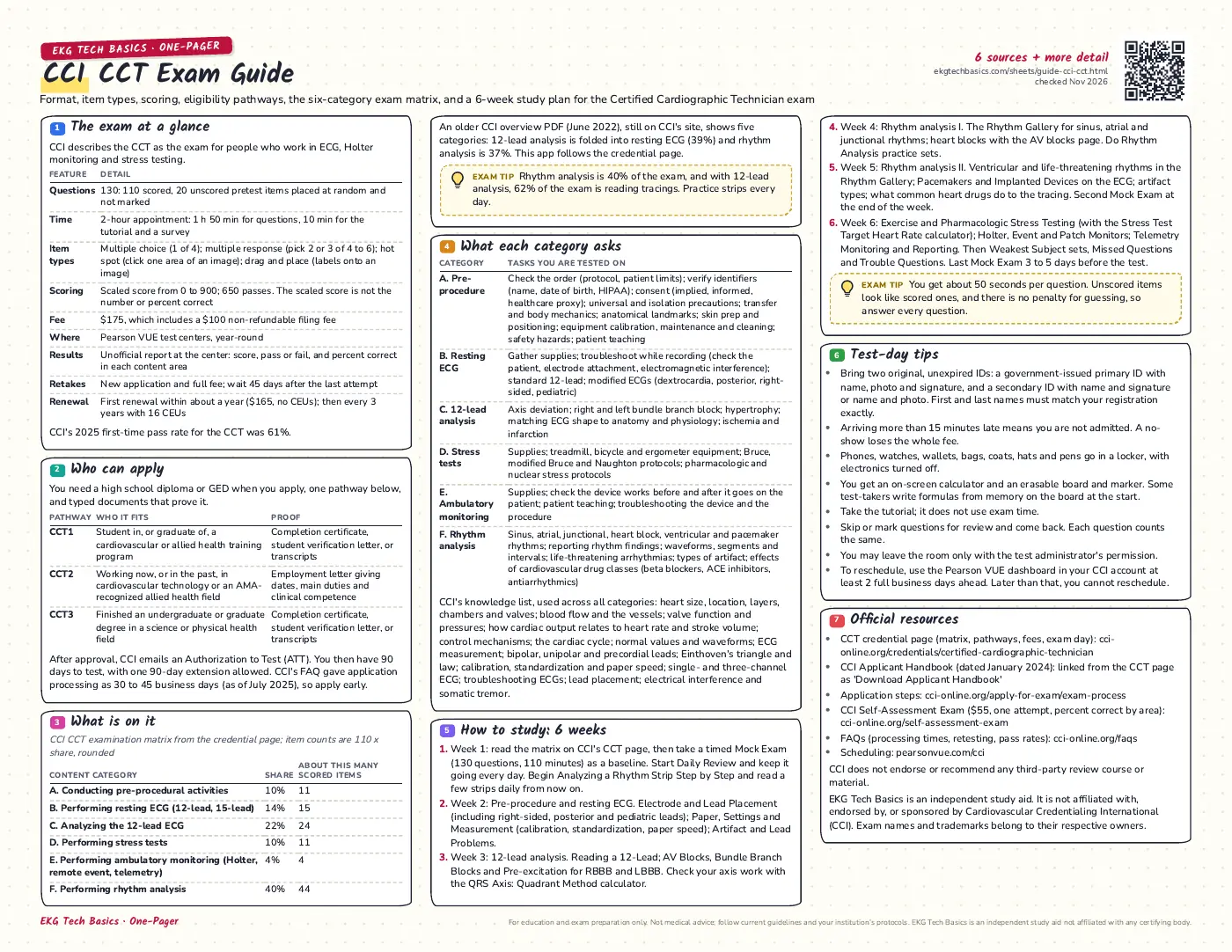
Format, item types, scoring, eligibility pathways, the six-category exam matrix, and a 6-week study plan for the Certified Cardiographic Technician exam
Practice CCI CCT questions free
The exam at a glance
CCI describes the CCT as the exam for people who work in ECG, Holter monitoring and stress testing.
| Feature | Detail |
|---|---|
| Questions | 130: 110 scored, 20 unscored pretest items placed at random and not marked |
| Time | 2-hour appointment: 1 h 50 min for questions, 10 min for the tutorial and a survey |
| Item types | Multiple choice (1 of 4); multiple response (pick 2 or 3 of 4 to 6); hot spot (click one area of an image); drag and place (labels onto an image) |
| Scoring | Scaled score from 0 to 900; 650 passes. The scaled score is not the number or percent correct |
| Fee | $175, which includes a $100 non-refundable filing fee |
| Where | Pearson VUE test centers, year-round |
| Results | Unofficial report at the center: score, pass or fail, and percent correct in each content area |
| Retakes | New application and full fee; wait 45 days after the last attempt |
| Renewal | First renewal within about a year ($165, no CEUs); then every 3 years with 16 CEUs |
CCI's 2025 first-time pass rate for the CCT was 61%.
Who can apply
You need a high school diploma or GED when you apply, one pathway below, and typed documents that prove it.
| Pathway | Who it fits | Proof |
|---|---|---|
| CCT1 | Student in, or graduate of, a cardiovascular or allied health training program | Completion certificate, student verification letter, or transcripts |
| CCT2 | Working now, or in the past, in cardiovascular technology or an AMA-recognized allied health field | Employment letter giving dates, main duties and clinical competence |
| CCT3 | Finished an undergraduate or graduate degree in a science or physical health field | Completion certificate, student verification letter, or transcripts |
After approval, CCI emails an Authorization to Test (ATT). You then have 90 days to test, with one 90-day extension allowed. CCI's FAQ gave application processing as 30 to 45 business days (as of July 2025), so apply early.
What is on it
| Content category | Share | About this many scored items |
|---|---|---|
| A. Conducting pre-procedural activities | 10% | 11 |
| B. Performing resting ECG (12-lead, 15-lead) | 14% | 15 |
| C. Analyzing the 12-lead ECG | 22% | 24 |
| D. Performing stress tests | 10% | 11 |
| E. Performing ambulatory monitoring (Holter, remote event, telemetry) | 4% | 4 |
| F. Performing rhythm analysis | 40% | 44 |
An older CCI overview PDF (June 2022), still on CCI's site, shows five categories: 12-lead analysis is folded into resting ECG (39%) and rhythm analysis is 37%. This app follows the credential page.
What each category asks
| Category | Tasks you are tested on |
|---|---|
| A. Pre-procedure | Check the order (protocol, patient limits); verify identifiers (name, date of birth, HIPAA); consent (implied, informed, healthcare proxy); universal and isolation precautions; transfer and body mechanics; anatomical landmarks; skin prep and positioning; equipment calibration, maintenance and cleaning; safety hazards; patient teaching |
| B. Resting ECG | Gather supplies; troubleshoot while recording (check the patient, electrode attachment, electromagnetic interference); standard 12-lead; modified ECGs (dextrocardia, posterior, right-sided, pediatric) |
| C. 12-lead analysis | Axis deviation; right and left bundle branch block; hypertrophy; matching ECG shape to anatomy and physiology; ischemia and infarction |
| D. Stress tests | Supplies; treadmill, bicycle and ergometer equipment; Bruce, modified Bruce and Naughton protocols; pharmacologic and nuclear stress protocols |
| E. Ambulatory monitoring | Supplies; check the device works before and after it goes on the patient; patient teaching; troubleshooting the device and the procedure |
| F. Rhythm analysis | Sinus, atrial, junctional, heart block, ventricular and pacemaker rhythms; reporting rhythm findings; waveforms, segments and intervals; life-threatening arrhythmias; types of artifact; effects of cardiovascular drug classes (beta blockers, ACE inhibitors, antiarrhythmics) |
CCI's knowledge list, used across all categories: heart size, location, layers, chambers and valves; blood flow and the vessels; valve function and pressures; how cardiac output relates to heart rate and stroke volume; control mechanisms; the cardiac cycle; normal values and waveforms; ECG measurement; bipolar, unipolar and precordial leads; Einthoven's triangle and law; calibration, standardization and paper speed; single- and three-channel ECG; troubleshooting ECGs; lead placement; electrical interference and somatic tremor.
How to study: 6 weeks
- Week 1: read the matrix on CCI's CCT page, then take a timed Mock Exam (130 questions, 110 minutes) as a baseline. Start Daily Review and keep it going every day. Begin Analyzing a Rhythm Strip Step by Step and read a few strips daily from now on.
- Week 2: Pre-procedure and resting ECG. Electrode and Lead Placement (including right-sided, posterior and pediatric leads); Paper, Settings and Measurement (calibration, standardization, paper speed); Artifact and Lead Problems.
- Week 3: 12-lead analysis. Reading a 12-Lead; AV Blocks, Bundle Branch Blocks and Pre-excitation for RBBB and LBBB. Check your axis work with the QRS Axis: Quadrant Method calculator.
- Week 4: Rhythm analysis I. The Rhythm Gallery for sinus, atrial and junctional rhythms; heart blocks with the AV blocks page. Do Rhythm Analysis practice sets.
- Week 5: Rhythm analysis II. Ventricular and life-threatening rhythms in the Rhythm Gallery; Pacemakers and Implanted Devices on the ECG; artifact types; what common heart drugs do to the tracing. Second Mock Exam at the end of the week.
- Week 6: Exercise and Pharmacologic Stress Testing (with the Stress Test Target Heart Rate calculator); Holter, Event and Patch Monitors; Telemetry Monitoring and Reporting. Then Weakest Subject sets, Missed Questions and Trouble Questions. Last Mock Exam 3 to 5 days before the test.
Test-day tips
- Bring two original, unexpired IDs: a government-issued primary ID with name, photo and signature, and a secondary ID with name and signature or name and photo. First and last names must match your registration exactly.
- Arriving more than 15 minutes late means you are not admitted. A no-show loses the whole fee.
- Phones, watches, wallets, bags, coats, hats and pens go in a locker, with electronics turned off.
- You get an on-screen calculator and an erasable board and marker. Some test-takers write formulas from memory on the board at the start.
- Take the tutorial; it does not use exam time.
- Skip or mark questions for review and come back. Each question counts the same.
- You may leave the room only with the test administrator's permission.
- To reschedule, use the Pearson VUE dashboard in your CCI account at least 2 full business days ahead. Later than that, you cannot reschedule.
Official resources
- CCT credential page (matrix, pathways, fees, exam day): cci-online.org/credentials/certified-cardiographic-technician
- CCI Applicant Handbook (dated January 2024): linked from the CCT page as 'Download Applicant Handbook'
- Application steps: cci-online.org/apply-for-exam/exam-process
- CCI Self-Assessment Exam ($55, one attempt, percent correct by area): cci-online.org/self-assessment-exam
- FAQs (processing times, retesting, pass rates): cci-online.org/faqs
- Scheduling: pearsonvue.com/cci
CCI does not endorse or recommend any third-party review course or material.
EKG Tech Basics is an independent study aid. It is not affiliated with, endorsed by, or sponsored by Cardiovascular Credentialing International (CCI). Exam names and trademarks belong to their respective owners.
In depth
The one-page summary above is what the PDF prints. These sections go further.
Applying, step by step
- Create an account (or sign in) at CCI's MyAccount portal, myaccount.cci-online.org.
- Choose the CCT application. If you are unsure of your pathway, use the qualification pathway tool on the CCT page.
- Upload your typed supporting documents as PDFs: school letters or transcripts for CCT1 and CCT3, an employer letter for CCT2. The handbook also asks for a clear copy of an unexpired government-issued photo ID whose first and last names match your account exactly.
- Pay the $175 fee by check, money order or card (American Express, Discover, MasterCard, Visa). Cash is not accepted.
- Wait for review. CCI's pages give different times (at least 15 to 20 business days on the CCT page; 30 to 45 business days in the FAQ as of July 2025). An incomplete application may take longer.
- When approved, CCI emails your ATT. Your 90-day window opens then. Schedule with Pearson VUE through the dashboard link in your CCI account.
- Incomplete application: you have 60 days to finish it. After that, CCI refunds the fee minus the $100 filing fee.
- Students may test before graduating, but CCI releases the credential and mails results only after proof of graduation.
- Criminal matters: you may ask for a pre-application review ($50, non-refundable) before you apply.
- Accommodations: send a letter signed by you and a qualified evaluator, with the evaluator's credentials, with every application, including retakes.
Changing your date, extensions and refunds
| Situation | What CCI allows |
|---|---|
| Reschedule within your window | Through Pearson VUE at least 2 full business days before the appointment |
| Cannot test in your 90 days | One 90-day extension of the ATT; request it in your CCI account (Cancel Exam, then Extension). Cancel any Pearson appointment first |
| Want a refund | Cancel with Pearson VUE first, then request it in your CCI account before your first 90-day window ends. Refund is the fee minus $100; none after the first window expires |
| Within 2 working days of the test | No refund |
| No-show, or extension window runs out | Fee lost; you must apply again |
| Death in the family, hospitalization or similar crisis | CCI may move your window without penalty; send written proof within 3 days of the original test date |
Scores, retakes and appeals
- The score is based only on the 110 scored items. The number correct needed for 650 was set by a standard-setting study, which CCI reviews from time to time.
- The category percentages on your report do not add up to your total score, because each category has a different number of items.
- An electronic score report is emailed the day after the exam. If you pass, the official letter, certificate and wallet card come by mail in about 15 to 20 business days.
- Score verification costs $50 and is a written request. It rechecks that answers were counted correctly; it does not review the questions.
- To retake: submit a new application and fee. You may reapply the day after testing, and documents from the last 2 years can be reused, but you cannot test again until 45 days have passed.
- Appeals about eligibility or results go in writing to CCI within 30 calendar days of the decision; CCI replies within 10 business days with the status or next steps.
If you need a retake, use the per-category percentages on your report to plan it, and start the app's Weakest Subject sets with your lowest category.
Keeping the credential
| Step | Requirement |
|---|---|
| First renewal | Due 9 to 12 months after you pass, by the first day of the same calendar quarter the next year (pass in April to June, renew by March 31). $165 and a signed Code of Ethics; no CEUs |
| Every 3 years after | $165, a signed Code of Ethics and 16 CEUs in any medical-related field |
| Another way to meet CEUs | Retake and pass the CCT once every 3 years, at the full exam fee |
| Missed the date | 3-month grace period: $165 plus a $50 late fee, the signed Code of Ethics and the CEU attestation. Then a probation period: retake and pass the CCT, or pay $165 plus a $100 penalty, finish the cycle's CEUs and earn 10 more cardiovascular CEUs. After probation, you must apply again and pass the exam |
CCI audits CEUs rather than collecting them all, so keep your certificates until the end of the next 3-year cycle.
The two CCI matrices side by side
| Category | Credential page (used here) | Overview PDF, June 2022 |
|---|---|---|
| Pre-procedural activities | 10% | 10% |
| Resting ECG | 14% | 39% (includes 12-lead analysis) |
| 12-lead analysis | 22% | Part of resting ECG |
| Stress tests | 10% | 10% |
| Ambulatory monitoring | 4% | 4% |
| Rhythm analysis | 40% | 37% |
- The tasks are almost the same. The PDF lists '15-lead, pediatric ECG' as its own task; the page lists pediatric with the modified ECGs.
- Ambulatory: the PDF names Holter, event, telemetry, transtelephonic and pacemaker monitoring, and has a task for attaching leads (stress loops, pouch). The page names Holter, remote event and telemetry, and has patient teaching instead.
- Either way, about three-quarters of the exam is the resting ECG, the 12-lead and rhythm strips (76% on both).
CCI's suggested textbooks and self-assessment
- Shier, Butler and Lewis: Hole's Essentials of Human Anatomy and Physiology
- Booth and O'Brien: Electrocardiography for Healthcare Professionals
- Dubin: Rapid Interpretation of EKG's
- Wagner and Marriott (Strauss in the PDF's listing): Marriott's Practical Electrocardiography
CCI calls these suggestions only: any general text on cardiovascular techniques and cardiac patient care will do, older or newer editions are fine, and you do not need all of them.
The CCI Self-Assessment Exam costs $55 and is matched to the exam matrix. You get one attempt per purchase, must start within a year, and have 72 hours to finish once you start. It reports percent correct in each content area but does not show the questions or explain missed items, and CCI says it is not a study guide or a predictor of passing. It is most useful in week 5, after the content weeks.
Sources
- Cardiovascular Credentialing International. Certified Cardiographic Technician (CCT) credential page: exam fee, testing time, qualification pathways, examination matrix and task list, exam preparation, exam day, scoring and maintaining credentials. Accessed November 15, 2026. Link
- Cardiovascular Credentialing International. CCI Applicant Handbook, publication date January 2024 (file posted under 2022/12 as CCI-Applicant-Handbook-Dec2022.pdf). Link
- Cardiovascular Credentialing International. Certified Cardiographic Technician (CCT) Examination Overview, publication date June 2022. Link
- Cardiovascular Credentialing International. Exam Application Process Steps. Accessed November 15, 2026. Link
- Cardiovascular Credentialing International. Frequently Asked Questions (application processing, retesting, 2025 pass rates, renewal). Accessed November 15, 2026. Link
- Cardiovascular Credentialing International. Self-Assessment Exam. Accessed November 15, 2026. Link